







Are Smart Rings Replacing Smart Watches The Shocking Truth
The wearable technology sector, once a monolithic market dominated by the wrist-worn “computer,” is undergoing a tectonic shift. For over a decade, the smartwatch has reigned supreme as the primary vehicle for digital health monitoring, communication, and productivity. However, the period between 2024 and 2026 has witnessed the ascent of the smart ring—a form factor that challenges the very premise of what a wearable device should be. The central question facing consumers, investors, and industry stakeholders is no longer just “which device should I buy?” but rather “is the smartwatch obsolete?”
Current market data suggests a nuanced reality that defies a simple binary answer. While smartwatches retain dominance in active fitness tracking, real-time communication, and app interactivity, smart rings are aggressively cannibalizing market share in the domains of sleep medicine, recovery analytics, and continuous, passive health monitoring. The global smart ring market is projected to grow at a Compound Annual Growth Rate (CAGR) exceeding 30% through 2032, a trajectory that significantly outpaces the mature smartwatch sector.
This comprehensive report provides an exhaustive analysis of this paradigm shift. We explore the ergonomic and physiological advantages that allow rings to outperform watches in specific biometric applications, the economic forces driving this new hardware category, and the emerging consumer behavior of “dual-wielding.” By synthesizing data from market forecasts, patent filings, user sentiment analysis, and technical specifications of flagship devices like the Oura Ring 4, Samsung Galaxy Ring, and Apple Watch Series 10, we conclude that smart rings are not merely replacing smartwatches—they are redefining the boundaries of personal technology.

The Wearable Market Landscape: Economic Trajectories and Consumer Adoption
To understand the potential of smart rings to replace smartwatches, we must first analyze the economic velocity and market maturity of both form factors. The data reveals a sector transitioning from a startup-driven niche to a battleground for global technology titans.
1.1 The Smart Ring Explosion: Valuation and Growth Projections
The smart ring market is currently in the “early majority” phase of the innovation diffusion curve. In 2024, the global smart ring market was valued at approximately USD 706.5 million. Projections indicate a meteoric rise, with estimates suggesting the market will reach USD 7.35 billion by 2032, representing a CAGR of 30.7% Other analyses are even more bullish, forecasting a CAGR of 36.8% between 2024 and 2029, driven by the intense digitization of the global economy and the integration of advanced features like NFC payments.
This growth is not merely a function of novelty; it is structural. The smart ring segment addresses a previously unmet need for “invisible” technology—devices that gather data without demanding attention. Unlike the smartwatch market, which is approaching saturation with a more modest CAGR of approximately 15.4% , the smart ring sector is expanding through greenfield opportunities. Consumers who previously rejected wearables due to the aesthetic intrusion of a screen or the fatigue of daily charging are now entering the market via the ring form factor.
1.2 The Smartwatch Fortress: Maturity and Saturation
In contrast, the smartwatch market is a behemoth. Valued at USD 33.58 billion in 2024, it is projected to reach USD 105.20 billion by 2032 While the percentage growth is lower than that of rings, the absolute dollar value remains vastly superior. This indicates that while rings are the fastest-growing segment, watches remain the revenue engine of the wearable industry.
However, the smartwatch market faces “innovator’s dilemma” challenges. The form factor has largely stabilized, with year-over-year improvements becoming incremental (e.g., slightly brighter screens, marginal battery gains) rather than revolutionary. This stagnation opens the door for disruptive form factors like the smart ring to capture consumer imagination and wallet share, particularly among demographics seeking specific utility—such as sleep tracking—that watches struggle to provide comfortably.
1.3 Regional Adoption Dynamics
The geographic distribution of adoption highlights key cultural and economic drivers:
- North America: This region dominates the current market, holding approximately 45% of the medical wearables share and 35.10% of the wearable AI market.The adoption here is fueled by high disposable income, a mature healthcare infrastructure that integrates wearable data, and a cultural predilection for “biohacking” and self-optimization. The presence of key players like Apple, Google (Fitbit), and Garmin anchors this dominance.
- Asia-Pacific: Projected to be the fastest-growing region, the APAC market is driven by proactive government initiatives promoting digital health in nations like China and India.The proximity to manufacturing hubs in Shenzhen and the rapid adoption of mobile payments via NFC are accelerating the uptake of smart rings as payment vehicles.
- Europe: European adoption is heavily influenced by privacy-conscious consumers who prefer the data-minimization ethos of screen-free devices. The market in the UK and Germany is expanding rapidly, with a focus on medical-grade applications and chronic disease management.
1.4 The Ecosystem War: Major Players and Strategic Positioning
The competitive landscape has shifted from a fragmented field of startups to a consolidated war between ecosystem giants.
- Oura Health: The pioneer and incumbent leader. Oura defined the category and continues to lead in mindshare. Their pivot to a subscription model ($5.99/mo) signals a broader industry trend: the realization that the hardware is merely a vessel for the true product—data interpretation and coaching.
- Samsung: The entry of the Galaxy Ring in 2024 marked the legitimization of the form factor. Samsung’s strategy is one of integration rather than replacement. By designing the Galaxy Ring to work in tandem with the Galaxy Watch (improving battery life and data accuracy when worn together), Samsung is attempting to sell two devices instead of one, creating a “lock-in” effect for its ecosystem.
- Apple: As of early 2026, Apple remains the “dark matter” of the smart ring universe. Its absence is conspicuous. Analysts speculate that Apple is observing the market maturity before entering, likely with a device that emphasizes health interoperability and perhaps gesture control for its Vision Pro headset.
- The Challengers (RingConn, Ultrahuman): These companies are carving out significant market share by attacking the incumbents’ weaknesses—specifically, subscription fatigue. By offering high-fidelity tracking without monthly fees, brands like RingConn and Ultrahuman are appealing to price-sensitive consumers and those ideologically opposed to “renting” their health data.
The Physics of Biometrics: Why the Finger Beats the Wrist
The debate between smart rings and smart watches is often framed as a matter of preference. However, at a fundamental engineering level, it is a debate about signal physics. The anatomical differences between the finger and the wrist dictate the quality of biometric data each device can capture, fundamentally influencing their utility for health tracking.
2.1 The Arterial Advantage
The finger is an anatomically superior site for photoplethysmography (PPG) sensors compared to the wrist.
- Capillary Density: The underside (palmar aspect) of the finger is rich in capillaries and is fed by the proper palmar digital arteries. These arteries are relatively close to the skin’s surface.
- Tissue Composition: The wrist is a complex intersection of bone (radius and ulna), tendons, and muscle. These structures create “noise” when light is shined through them. In contrast, the finger has less interfering mass between the sensor and the blood flow.
- Signal Strength: Because of these factors, the PPG signal obtained from a finger is often 10 to 50 times stronger than that obtained from the wrist. This high Signal-to-Noise Ratio (SNR) allows for more precise detection of the pulse wave, enabling the measurement of minute variations in heart beats (Heart Rate Variability) and subtle changes in blood oxygenation.
2.2 The Stability Factor
Wearable sensors rely on consistent contact with the skin.
- The Wrist Problem: A watch is heavy and top-heavy. As the arm moves during sleep or exercise, the watch head can slide, break contact, or let ambient light leak into the sensor. To combat this, users must strap the watch tightly, which can be uncomfortable or restrict blood flow.
- The Ring Solution: A properly sized ring sits snugly against the skin. Its light weight (2-4 grams) means inertia does not cause it to bounce or slide during movement. This stability ensures continuous data fidelity, particularly during sleep when the user might toss and turn.
2.3 Thermal Sensing Capabilities
Temperature is a vital sign that is often overlooked in consumer wearables, yet it is critical for cycle tracking and illness detection.
- Peripheral Perfusion: The fingers are extremities that are highly responsive to vasoconstriction and vasodilation. This makes them sensitive indicators of the body’s thermoregulatory status.
- Accuracy: Smart rings like the Oura use Negative Temperature Coefficient (NTC) sensors that can detect changes as small as 0.01°C. The distal position of the ring allows it to capture these peripheral temperature shifts more rapidly than a wrist-worn device, which is located closer to the body’s core thermal mass and insulated by thicker tissue.
2.4 Form Factor Constraints and Engineering Challenges
Despite the sensor advantages, the ring form factor imposes severe engineering constraints that limit its capabilities.
- Volume: A smart ring has a volume of approximately 300-500 cubic millimeters. Into this space, engineers must fit a battery, motherboard, sensors, and antennas.
- Battery Density: The battery in a smart ring is typically 15-22 mAh. In comparison, an Apple Watch Ultra has a battery approaching 564 mAh. This massive disparity dictates that rings cannot support power-hungry components like GPS modules, LTE modems, or bright OLED screens.
- Thermal Management: Even if a battery could support a powerful processor, the heat generated would have nowhere to dissipate. A hot ring on a finger is a safety hazard. This thermal constraint effectively caps the processing power of smart rings, forcing them to rely on smartphones for heavy computational lifting.
The Battle for Sleep: Where Rings Have Already Won
If there is one domain where the smart ring has effectively “replaced” the smartwatch, it is sleep medicine and recovery tracking. The ergonomic and psychological advantages of the ring have made it the de facto standard for consumers prioritizing sleep hygiene.
3.1 The “Princess and the Pea” Effect: Ergonomics of Sleep
A significant barrier to smartwatch adoption for sleep tracking is physical discomfort.
- Bulk and Obstruction: Wearing a 60-gram block of titanium and glass (like the Apple Watch Ultra) to bed is physically intrusive. Users report the watch snagging on sheets, pressing into their face if they sleep with hands near their head, or causing sweat and irritation on the wrist.
- The Light Pollution Problem: Smartwatches are light emitters. Even with “Sleep Mode” or “Theater Mode” enabled, the risk of accidental activation (e.g., via the Digital Crown or accelerometer) remains. A sudden blast of 2000-nit light in a dark room disrupts melatonin production and can jolt the user out of deep sleep.
- The Ring Advantage: Smart rings are “invisible” to the sleeper. They have no screens to light up. They are smooth and snag-free. Once accustomed to the feeling of a ring, most users report forgetting they are wearing it. This comfort leads to higher compliance—users actually wear the device every night, leading to consistent long-term data sets.
3.2 Algorithmic Superiority in Sleep Staging
The stability of the finger-based sensor allows for superior sleep staging algorithms.
- Sleep Architecture: Accurately distinguishing between Light, Deep (Slow Wave), and REM sleep requires precise measurement of HRV and movement. The high-fidelity signal from the ring allows algorithms to detect the subtle autonomic shifts that accompany sleep stages (e.g., the “dip” in heart rate during deep sleep vs. the volatility during REM).
- Comparative Studies: Research cited in the snippets indicates that Oura rings have demonstrated high alignment with Polysomnography (PSG)—the medical gold standard—for total sleep time and sleep efficiency. While no wearable is perfect, the ring’s ability to minimize “motion artifacts” gives it a distinct edge over the wrist in the quiet, stillness of the bedroom.
- SpO2 and Apnea: The ring’s secure fit is particularly advantageous for Pulse Oximetry (SpO2). Measuring blood oxygen requires the user to be still. Rings maintain this stability naturally, whereas a watch might gap during sleep movement. This allows rings to reliably track breathing disturbances and provide early indicators of sleep apnea.
3.3 Battery Life: The Continuity of Care
Sleep tracking requires a device to be worn during the one time most people charge their electronics: the night.
- The Smartwatch Paradox: An Apple Watch Series 10 has an 18-hour battery life. If a user wears it all day, they must charge it before bed to track sleep. If they forget, or if the charge is insufficient, the data is lost. This creates “charge anxiety” and friction.
- The Ring Solution: Smart rings last 4 to 7 days on a single charge. A user can track sleep for nearly a week without removing the device. Charging can occur during low-value times (e.g., showering or working at a desk). This longevity ensures unbroken data continuity, which is essential for establishing reliable baselines for RHR and HRV.
Active Lifestyle and Fitness: The Smartwatch’s Unassailable Fortress
While smart rings dominate the night, the smartwatch remains the undisputed king of the day—specifically, the active day. For the athlete, the runner, and the bio-quantifier, the ring is an insufficient replacement for the watch.
4.1 The Necessity of Real-Time Feedback
The primary deficit of the smart ring in fitness is the lack of a screen.
- The “Black Box” Problem: A smart ring is a passive data collector. It records what you did, but it cannot tell you how you are doing in the moment. A runner cannot glance at their ring to check their pace. A cyclist cannot see their heart rate zone. A weightlifter cannot see their rest interval timer.
- The Feedback Loop: Athletic performance relies on real-time feedback loops. Smartwatches provide this instant data, allowing the user to adjust their effort, cadence, or form mid-activity. This interactivity is fundamental to training, and rings cannot replicate it without a secondary device (phone) or audio cues.
4.2 The GPS Dependency
Global Positioning System (GPS) tracking is the “killer app” for outdoor fitness.
- Power and Space: As established, rings lack the volume and battery density to house GPS modules.
- Tethering: To track a run with a smart ring, the user must carry their smartphone to “tether” the GPS data. This negates the “freedom” aspect of wearables.
- Watch Independence: Devices like the Apple Watch Ultra or Garmin Fenix have independent, multi-band GPS. Users can leave their heavy phones at home and still capture precise route data, elevation metrics, and pace. For the serious outdoor enthusiast, this capability is non-negotiable.
4.3 High-Intensity Interval Training (HIIT) and Sensor Limitations
While rings are accurate at rest, their performance degrades during certain types of high-intensity activity.
- Grip Interference: In activities like weightlifting, CrossFit, tennis, or rowing, the user is gripping an object. This gripping action flexes the tendons and muscles of the finger, compressing the capillaries and displacing the ring sensor. This creates massive “motion artifacts” that can render heart rate data useless or highly inaccurate during the workout.
- Durability Risks: Wearing a ring while lifting heavy steel weights poses risks. The ring can be scratched or crushed (though titanium is strong), and more importantly, it can pinch the skin or cause “degloving” injuries in extreme accidents. Most strength athletes remove rings while lifting, creating data gaps. Watches, worn higher on the wrist, avoid this interference.
Health Insights: From Data to Wisdom
The modern wearable user demands more than just raw numbers; they demand insights. The shift from “tracking” to “coaching” is where the software battle is being fought.
5.1 Heart Rate Variability (HRV) and the Readiness Paradigm
HRV has emerged as the single most important metric for assessing recovery and autonomic nervous system balance.
- The Ring Approach (Holistic): Oura and Ultrahuman pioneered the “Readiness Score.” By analyzing HRV trends over the entire night, relative to the user’s long-term baseline, they provide a simple morning score (0-100) that tells the user how hard to push. This approach is passive, restorative, and focuses on the “why” of health. It encourages rest as much as activity.
- The Watch Approach (Active): Historically, smartwatches gamified activity (e.g., Apple’s “Closing the Rings”). This often encouraged users to push through fatigue to maintain streaks. While Apple has introduced the “Vitals” app in watchOS 11 to provide overnight ranges, the cultural legacy of the smartwatch is one of action and doing, whereas the ring is one of being and recovering.
5.2 Women’s Health: A Revolution on the Finger
Smart rings have become a pivotal tool for women’s health, leveraging their superior temperature sensing capabilities.
- Cycle Tracking: The minute temperature shifts (0.3°C to 0.5°C) that occur after ovulation are easily detected by finger-based sensors. This data allows for precise prediction of menstrual cycles and fertility windows.
- Integration: The partnership between Oura and Natural Cycles was a watershed moment, creating the first FDA-cleared birth control method powered by a wearable. The Galaxy Ring has followed suit with similar cycle tracking features. This utility makes the ring indispensable for a massive demographic segment, solving a problem that wrist-based wearables struggled with due to lower thermal sensitivity.
5.3 Illness Detection and Symptom Radar
The combination of continuous temperature, HRV, and respiratory rate monitoring allows smart rings to act as “early warning systems” for the immune system.
- Predictive Health: Users frequently report that their “Readiness” scores drop and body temperature spikes 24-48 hours before they feel sick. This capability, highlighted during the COVID-19 pandemic, remains a key selling point. The Oura Ring’s “Symptom Radar” formally tracks these deviations to alert users to potential illness, allowing them to rest early and potentially shorten the duration of sickness.
The “Dual-Wielding” Phenomenon: Convergence over Cannibalization
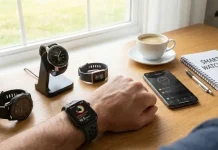
The data strongly suggests that for a significant portion of the market, the smart ring is not a replacement for the smartwatch, but a complement. This behavior, known as “dual-wielding,” represents a convergence of form factors.
6.1 The Best of Both Worlds Strategy
“Dual-wielders” optimize the strengths of both devices:
- Daytime: They wear a smartwatch for notifications, productivity, LTE connectivity, and active workout tracking.
- Nighttime: They switch to (or only wear) the smart ring for comfortable, high-fidelity sleep tracking.
- Data Aggregation: This behavior forces health platforms (Apple Health, Google Health Connect) to become the central hubs. The challenge becomes deduplicating data—ensuring that steps aren’t counted twice.
6.2 Ecosystem Synergy
Manufacturers are beginning to explicitly design for this behavior.
- Samsung’s Ecosystem Play: Samsung is the first major player to offer both a ring and a watch. When a user wears both a Galaxy Ring and a Galaxy Watch, the Samsung Health app automatically optimizes sensor usage. It might disable the ring’s heart rate sensor (to save the ring’s small battery) while using the watch’s larger battery for monitoring, or use the ring for sleep while the watch charges. This integration improves battery life for both devices and increases data accuracy
- The “Lock-In” Effect: This strategy is potent. By making the devices work better together, Samsung incentivizes users to buy both, increasing the average revenue per user (ARPU) and deepening ecosystem lock-in.
6.3 The “Mechanical Watch” Demographic
A vital, often overlooked segment of the smart ring market is the “style preserver.”
- The Aesthetic Conflict: Many consumers own luxury mechanical watches (Rolex, Omega) or simply prefer the classic aesthetic of an analog timepiece. For years, they faced a dilemma: wear a “dumb” luxury watch and lose health tracking, or wear a “smart” computer and sacrifice style.
- The Ring Solution: The smart ring resolves this conflict. It allows the user to wear their preferred mechanical watch on the wrist while discreetly collecting biometric data on the finger. For this demographic, the smart ring is enabling the continued use of traditional watches, rather than replacing smartwatches.

Comparative Technical Analysis: The Flagships Head-to-Head
To provide a concrete basis for comparison, we analyze the specifications of the current market leaders.
7.1 Table: Smart Ring vs. Smart Watch Flagship Comparison (2025/2026 Models)
| Feature | Oura Ring 4 | Samsung Galaxy Ring | Apple Watch Series 10 | Ultrahuman Ring Air |
| Price | $349 – $499 + Subscription | $399 (No Subscription) | $399+ | $349 (No Subscription) |
| Battery Life | Up to 8 Days | Up to 7 Days | ~18 Hours | Up to 6 Days |
| Weight | 3.3g – 5.2g | 2.3g – 3.0g | 30g – 36g | 2.4g – 3.6g |
| Water Resistance | 100m (Titanium) | 10ATM (IP68) | 50m (Swimproof) | 100m |
| Sleep Staging | Excellent (Medical Grade correlation) | Good (AI-enhanced) | Good (Vitals App) | Very Good |
| Sensors | PPG (Red/Green/IR), NTC Temp, Accel | PPG, NTC Temp, Accel | ECG, PPG, Temp, GPS, Depth | PPG, Temp, Accel |
| Active GPS | No (Phone Tethered) | No (Phone Tethered) | Yes (Built-in) | No (Phone Tethered) |
| Subscription | Yes ($5.99/mo) | No | No (Apple Fitness+ optional) | No |
| Ecosystem | iOS & Android | Android Only (Samsung optimized) | iOS Only | iOS & Android |
Data Sources:
7.2 Analysis of the Comparison
- Subscription Model: Oura stands alone with a mandatory subscription. While this funds their superior R&D and app development, it is a significant friction point. Samsung and Ultrahuman are exploiting this by offering “one-and-done” pricing.
- Platform Exclusivity: The Galaxy Ring’s restriction to Android (and optimization for Samsung phones) mirrors the Apple Watch’s restriction to iPhone. This fragments the market. Oura and Ultrahuman remain the “Switzerland” of wearables, working across both platforms, which is a massive strategic advantage for users who switch phones.
Future Horizons: 2026 and Beyond
The smart ring market is still in its technological adolescence. Emerging patents and R&D trends point to a future where rings may eventually challenge the smartwatch’s utility dominance through novel interfaces and sensors.
8.1 The “Control” Interface: The Ring as a Wand
A major limitation of rings is the lack of input. A recent Samsung patent reveals plans to change this.
- Gesture Control: Using advanced gyroscopes and perhaps localized radar (like Google’s Project Soli), future rings could detect subtle finger movements. A “snap” could take a photo; a “twist” could adjust volume; a “point” could navigate a smart TV interface.
- XR Integration: As Extended Reality (XR) headsets like the Vision Pro or Samsung’s upcoming XR headset become more common, the smart ring could become the primary controller. Hand tracking is good, but a ring provides haptic feedback and precise 6-DOF (Six Degrees of Freedom) tracking that cameras alone cannot match.
8.2 The Holy Grail: Continuous Glucose Monitoring (CGM)
Non-invasive glucose monitoring is the “moonshot” for all wearable companies.
- Optical Spectroscopy: Technology is being developed to use lasers to analyze interstitial fluid glucose levels through the skin.
- The Ring Advantage: The finger’s high density of blood vessels and thin skin might make it a more viable site for this technology than the wrist. If a smart ring can accurately track glucose without a needle, it would instantly become a medical necessity for millions of diabetics and a “must-have” for the metabolic health conscious, potentially eclipsing the smartwatch in utility.
8.3 Bio-Feedback and Ambient Computing
Patents from Ultrahuman suggest a move toward “Ambient Computing.”
- Light-Based Alerts: A patent describes a ring with embedded micro-LEDs or light-emitting polymers that can glow in different colors to signal health states. For example, the ring might glow a soft red if stress levels are high, prompting the user to breathe, or green if a recovery goal is met. This reintroduces a notification layer to the ring without the cognitive load of a text display.
Challenges and Barriers to Ubiquity
Despite the hype, smart rings face significant structural hurdles that may prevent them from ever fully replacing smartwatches for the mass market.
9.1 The Sizing Logistics Nightmare
Smartwatches are “one size fits most” thanks to adjustable straps. Smart rings must fit perfectly to function.
- The Friction of Purchase: To buy a smart ring, a user usually has to order a sizing kit, wait for it to arrive, wear a plastic dummy ring for 24 hours (to account for finger swelling), determine their size, and then order the actual device. This multi-step process introduces massive friction and delays gratification, reducing conversion rates compared to the instant gratification of buying a watch.
- Inventory Complexity: Retailers must stock 8-10 sizes for every color and finish. This SKU proliferation makes it difficult for physical stores (like Best Buy) to stock rings efficiently compared to watches.
9.2 Durability and Repairability
Rings occupy a dangerous place on the body.
- Wear and Tear: They are constantly banged against door handles, submerged in dishwater, and ground against weights. While titanium is durable, the aesthetic finishes (gold, black) often scratch or fade over time.
- E-Waste: Smart rings are almost universally sealed with epoxy resin to achieve waterproofing. This means they are non-repairable. When the tiny battery degrades after 2-3 years, the entire device is e-waste. Smartwatches, while difficult to repair, often have battery replacement services. This disposability is a long-term economic and environmental concern.
9.3 The Cost-Value Perception
For many consumers, the price is a barrier.
- The Screen Bias: A $400 Apple Watch has a Retina display, LTE, GPS, and a powerful processor. It feels like $400 worth of technology. A $400 Galaxy Ring or Oura Ring is a small loop of metal with no screen. Psychologically, it is harder for the average consumer to justify the same spend for a device that “does less,” even if the sensor technology inside is equally sophisticated.
Conclusion: The Great Divergence
The answer is No. But they are doing something more profound: they are forcing the smartwatch to evolve and creating a new parallel track of personal technology.
The smartwatch is establishing itself as a computer. It is an extension of the smartphone, designed for communication, navigation, active fitness tracking, and control. It appeals to the desire to manage the external world.
The smart ring is establishing itself as a biosensor. It is an extension of the body, designed for introspection, recovery, sleep hygiene, and passive observation. It appeals to the desire to understand the internal world.
We are moving toward a “Constellation Model” of wearables. In this future, the smartphone is the hub; the watch is the active interface; the ring is the passive monitor; and the earbuds are the auditory connection. For the general consumer, the smartwatch remains the most versatile tool. But for the sleep-conscious, the style-conscious, and the data-focused, the smart ring has rendered the smartwatch obsolete for those specific functions.