








How to Get Discord on PS4 Without PC: Proven Hack
In the contemporary landscape of digital interactive entertainment, the demarcation lines between hardware platforms—once rigid boundaries defining user experience—have become increasingly porous. The advent of cross-platform play (“crossplay”) has fundamentally altered the social fabric of gaming, necessitating communication infrastructures that transcend the proprietary “walled gardens” of console manufacturers. As of 2025, Discord has emerged not merely as a Voice over Internet Protocol (VoIP) application, but as the de facto social operating system for gaming communities, replacing the fragmented, peer-to-peer (P2P) voice lobbies of the previous decade.
However, this transition has highlighted a significant technological schism between current-generation architectures (PlayStation 5, Xbox Series X) and legacy systems like the PlayStation 4 (PS4). While the PS5 has integrated Discord voice capabilities at the firmware level—allowing for the native processing of VoIP packets alongside game telemetry—the PS4 remains bound by the constraints of the Orbis OS architecture, a FreeBSD-derivative designed in an era where background processing resources were aggressively conserved for rendering performance.
This report provides an exhaustive technical examination of the methodologies required to bridge this “Communication Gap” on the PS4. It explores the official, albeit limited, integration layers provided by Sony and Discord, before conducting a deep forensic analysis of the “workaround” ecosystems that have emerged. These range from software-based network bridging utilizing Remote Play protocols to complex analog signal mixing involving impedance matching, ground loop isolation, and Digital-to-Analog Converter (DAC) manipulation. Furthermore, we analyze the psychoacoustic and electrical challenges inherent in these solutions, providing a definitive resource for achieving seamless audio synchronization. Finally, we examine the market implications of this hardware gap through the lens of Search Engine Optimization (SEO) and content strategy, recognizing that the friction of connectivity drives a massive secondary market for information and peripherals.
1.1 The Hardware Constraint: Why PS4 Cannot Natively Run Discord
To understand the necessity of external workarounds, one must first appreciate the architectural limitations of the PS4. The console reserves specific CPU cores and a strict allocation of its 8GB GDDR5 Unified Memory for the active game application. Secondary applications, such as the web browser or media players, operate in a suspended state when a game is launched to prevent frame-rate degradation. Discord, being an Electron-based application (essentially a dedicated instance of the Chromium browser), is resource-intensive.
Running a full Discord instance with real-time encoding/decoding of Opus voice packets, noise suppression (Krisp), and encryption would require persistent background processing cycles that the Orbis OS hypervisor does not allocate to third-party apps. Consequently, while the PS5’s modern architecture permits this “system-level” integration, the PS4 is restricted to “Rich Presence” data transmission—sending status updates without processing audio. This hardware reality forces the user to externalize the voice processing load to a secondary device (smartphone or PC) and then physically or virtually mix the audio streams.
2. The Official Integration Layer: Telemetry Without Telephony
The partnership between Sony Interactive Entertainment and Discord, announced in 2021 and iteratively updated through 2025, represents the first tier of integration. While it does not solve the voice chat problem for PS4 users, it establishes the necessary authentication handshake required for social visibility.
2.1 The OAuth2 Authentication Protocol
The integration relies on the OAuth2 standard to link the user’s PlayStation Network (PSN) ID with their Discord UID. This process, initiated via the Discord client’s “Connections” tab, redirects the user to a Sony-hosted authentication portal.
Upon successful login, a token is generated that grants Discord limited read access to the PSN user’s activity feed. Crucially, this is a unidirectional data flow:
- Event Generation: The PS4 registers a state change (e.g., User launches Elden Ring).
- API Broadcast: The PSN backend pushes this status update to Discord’s Rich Presence Gateway.
- Client Rendering: Discord parses the JSON payload to update the user’s status message (e.g., “Playing Elden Ring on PS4”).
2.2 The Privacy “Data Silo” Configuration
A critical failure point in this integration is the PSN privacy architecture. Sony’s default privacy settings often categorize activity data as “Private” or “Friends Only.” Since the Discord API scraper acts as an external, third-party entity rather than a “Friend” on the PSN list, these restrictive settings block the data transmission entirely.
For the integration to function, users must manually reconfigure their visibility settings. The specific path, which has remained consistent through 2025 firmware updates, is as follows:
- Navigation: Settings > Account Management > Privacy Settings > Personal Info | Messaging.
- Critical Toggle: The “Online Status and Now Playing” parameter must be set to “Anyone”.
If this setting is restricted, the OAuth token remains valid, but the payload returned to Discord is empty, resulting in the user appearing “Online” but without game context.
2.3 Limitations of the Official Toolset
The official integration on PS4 is purely cosmetic. It satisfies the social requirement of “presence”—letting friends know a user is casino gaming—but provides zero utility for tactical communication. It does not bridge the Real-time Transport Protocol (RTP) packets used for voice. Users attempting to join a voice channel on PS4 via the dashboard will find no option to do so; unlike the PS5, which allows the transfer of a voice session from mobile to console, the PS4 lacks the audio subsystems to receive this transfer. Thus, the “official” method serves only as a status indicator, necessitating the hardware and software workarounds detailed in the subsequent sections.
3. The Browser-Based Interstice: A Study in WebKit Limitations
One of the most persistent “soft” workarounds involves exploiting the PS4’s built-in internet browser. As the browser is based on WebKit, it is theoretically capable of rendering the Discord web client (discord.com/app). However, practical application is hindered by the console’s aggressive resource management.
3.1 The JavaScript and WebSocket Constraints
To load the Discord web app, users must first ensure that JavaScript is enabled within the browser settings (Options > Settings > Enable JavaScript). Without this, the dynamic elements of the Discord interface (server lists, chat rendering) will fail to load.
Even with JavaScript active, the primary obstacle is background suspension. When the user minimizes the browser to return to a game, the Orbis OS suspends the browser process to reclaim RAM. This suspension severs the WebSocket connection used by Discord to maintain real-time text and voice updates. Consequently, the browser method is effective only as a “second screen” experience—useful for checking text channels during matchmaking or loading screens, but incapable of sustaining a voice call while the game is the active window.
3.2 Microphone Input blocking
Furthermore, the PS4 browser lacks the necessary permissions to access the DualShock 4’s microphone input for web-based VoIP. While the controller’s audio jack can output browser audio (allowing a user to hear a voice chat), the browser cannot capture the user’s voice to send back to Discord. This results in a “listen-only” mode, which defeats the purpose of two-way communication.
Attempts to bypass this using USB microphones often fail because the OS routes USB audio priority to the “Party Chat” system or the active game, locking the browser out of the exclusive mode required for low-latency audio capture.

4. Networked Audio Bridges: The Remote Play Protocol
Moving beyond simple browser exploits, the Remote Play Bridge represents a sophisticated software solution that aggregates audio by virtualizing the console environment on a secondary computer. This method leverages the Local Area Network (LAN) to transmit audio, bypassing the need for physical audio cables.
4.1 Architecture of the Remote Play Bridge
The setup essentially turns a PC (Windows or macOS) into an audio mixer for the console.
- The Host: The PS4 console runs the game.
- The Client: A PC on the same network runs the PS Remote Play application.
- The Aggregation: The Remote Play app receives a video and audio stream from the PS4. The user connects their headset to the PC, not the PS4.
- The Mix: The user runs the Discord desktop client on the same PC.
- Result: The user hears game audio (via Remote Play) and Discord audio (via Discord App) simultaneously through the PC headset. The PC microphone sends voice to Discord.
4.2 The “Dummy Account” Mechanism
A major limitation of Remote Play is that connecting a controller to the PC often deactivates the controller connected to the PS4. To circumvent this and play with a controller directly connected to the console (to avoid input lag), users employ a Secondary Account Strategy:
- Step 1: Create a secondary PSN account (the “Dummy”).
- Step 2: Log into Remote Play on the PC using the Dummy account details.
- Step 3: The Remote Play stream initiates, displaying the PS4 screen on the PC.
- Step 4: On the actual PS4, the user presses the PS button on their primary controller and logs into their Main account.
- Outcome: The Remote Play session continues in the background (streaming audio to the PC), while the user controls the game directly on the PS4 using their primary account. This eliminates the input latency associated with controlling the game through the PC stream, while retaining the audio link.
4.3 Advanced Routing: Voicemeeter Banana Implementation
For users requiring granular control over audio levels (e.g., ducking game audio when someone speaks), virtual mixing software like Voicemeeter Banana is integrated into this stack.
- Virtual Input 1: Remote Play Audio (Game Sound).
- Virtual Input 2: Discord Audio (Chat Sound).
- Hardware Output: Physical Headset.
- Hardware Input: Physical Microphone.
- Virtual Output: Discord Input (Microphone).
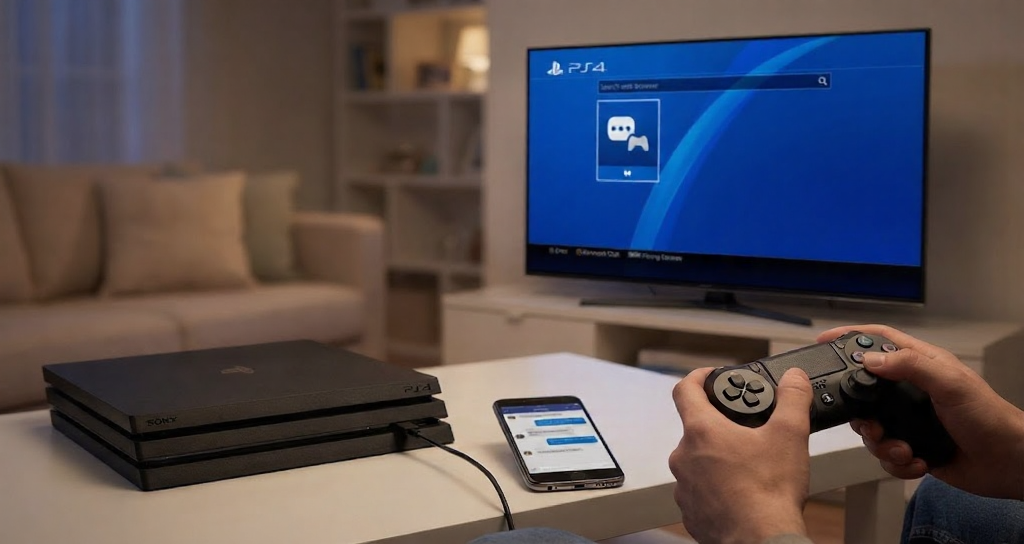
Snippet details a specific diagrammatic approach where the user routes the phone’s audio (if using a mobile device instead of PC) into the PC’s line-in, utilizing Voicemeeter to mix the analog signal with the digital Discord stream. This hybrid approach allows for complex noise gating and equalization (EQ) that the PS4 natively lacks.
4.4 Latency and Bandwidth Dependencies
The viability of this method is entirely dependent on network stability. The Remote Play protocol streams 720p/1080p video alongside audio. Even if the user is only listening, the video bandwidth is consumed. On Wi-Fi connections, this can introduce jitter, resulting in audio dropouts or “robotic” artifacts. A wired Ethernet connection (Cat5e/Cat6) for both the PS4 and the PC is strongly recommended to maintain the low-latency (sub-50ms) synchronization required for gaming.
5. Analog Signal Aggregation: The Physics of “The Mix”
For users lacking a robust PC or high-speed local network, the industry standard for PS4 Discord integration is Analog Audio Mixing. This involves physically combining the electrical signals from the PS4 controller and a mobile device (running the Discord app) into a single headset. While conceptually simple, this method introduces complex challenges regarding impedance matching and ground loops.
5.1 The TRRS Topography: CTIA vs. OMTP
The foundation of this setup is the 3.5mm jack. Modern gaming headsets and the DualShock 4 controller utilize the TRRS (Tip-Ring-Ring-Sleeve) connector to carry stereo audio and a mono microphone signal on a single plug.
- CTIA Standard: Used by Sony (PS4), Microsoft (Xbox), and Apple. The pinout is Audio Left (Tip), Audio Right (Ring 1), Ground (Ring 2), Microphone (Sleeve).
- OMTP Standard: Used by older devices. It swaps the Ground and Microphone bands.
- The Conflict: Plugging an OMTP splitter into a PS4 controller results in a phase-cancelled, “hollow” sound and a non-functional mic. Users must ensure all splitters and aux cables purchased for this workaround are explicitly marked CTIA compliant or “Compatible with iPhone/PS4”.
5.2 The Splitter vs. Mixer Distinction
A common misconception is that a simple “Y-Splitter” (one male, two female) can effectively mix audio. In reality, connecting two active output sources (the phone’s headphone amp and the controller’s headphone amp) directly together without resistance poses risks.
- Impedance Fighting: The device with lower output impedance (often the phone) will drive current into the output stage of the other device, potentially causing distortion or hardware damage over time.
- Volume Attenuation: Passive mixing inevitably results in a signal drop (insertion loss).
- The Solution: A dedicated Gaming Audio Mixer cable (such as those by Cubilux or legacy Astro cables) contains inline summing resistors. These resistors prevent the sources from back-feeding into each other, allowing for a clean mix.
5.3 Wiring Diagram: The “Mobile Bridge” Setup
The most functional low-cost setup involves the following signal chain :
Audio Source A: PS4 Controller (Game Audio).
- Audio Source B: Smartphone (Discord Voice).
- Interface: A 4-Pole (TRRS) Audio Splitter (often marketed as a “Headset Splitter” with separate Mic and Headphone jacks).
- Signal Path:
- An Aux cable connects the Phone to the Mic Input of the splitter (Warning: This often fails as phones expect a mic input, not output. The correct topology uses a specialized mixer or the Elgato Chat Link described in Section 7).
- Verified Workaround: The user wears earbuds connected to the phone (underneath) and a gaming headset connected to the PS4 (overtop). This is the “low-tech” solution.
- The “Aux Mixer”: Connect the PS4 Audio and Phone Audio into a passive mixer (like a Belkin Rockstar). Connect headphones to the mixer output. Trade-off: The user must use the phone’s internal mic for Discord, as the passive mixer typically does not route the headset mic back to the phone.
6. The Ground Loop Anomaly: Diagnosis and Mitigation
When connecting two devices that are both grounded to different potentials (e.g., a PS4 controller charging via USB and a phone charging via a wall adapter), a Ground Loop is formed. This is the single most common complaint in Discord bridging setups.
6.1 The Physics of the “Buzz”
A ground loop occurs when there are multiple paths to the earth ground, creating a closed loop of conductors. Stray magnetic fields (from mains wiring) induce a current in this loop. Since the audio cable’s shield is part of this loop, this induced current manifests as a voltage fluctuation relative to the signal ground.
- Audible Result: A persistent 60Hz hum (in 60Hz power regions) or a high-pitched “alternator whine” caused by the switching frequency of the USB power supplies.
- Charging Factor: The noise is almost always exacerbated when the controller or phone is plugged into a charger while being used for audio.
6.2 The Solution: Ground Loop Noise Isolators
To eliminate this, a Ground Loop Noise Isolator must be inserted into the signal chain (between the Aux cable and the Mixer).
- Mechanism: These devices contain a 1:1 audio transformer. The signal is transmitted from the primary coil to the secondary coil via magnetic induction. There is no direct DC electrical connection (galvanic isolation) between the input and output. This breaks the conductive loop, stopping the induced current while allowing the AC audio signal to pass.
- Frequency Response Trade-off: Cheaper isolators often suffer from magnetic saturation at low frequencies, causing a roll-off in bass response (e.g., explosions in games sound tinny). Higher-quality isolators use Permalloy cores to maintain linearity.
6.3 Market Analysis: Besign vs. Mpow
In the niche market of 3.5mm isolators, two brands dominate the user discourse: Besign and Mpow.
- Besign Ground Loop Isolator: High user sentiment for durability. Reviews indicate it effectively kills the “alternator whine” but introduces a slight volume drop (insertion loss) that requires the user to boost the phone volume.
- Mpow MA1: Historically the market leader, though availability fluctuates. It performs similarly but is noted for a compact form factor.
- Verdict: Both devices are functionally identical passive transformers. The choice largely depends on availability. Using either is mandatory for a clean Discord in roblox experience on PS4 when cables are involved.

7. Advanced Interfaces: DACs, MixAmps, and The Audiophile Approach
For users prioritizing audio fidelity over cost, dedicated external sound cards (DAC/Amps) provide a robust solution that bypasses the inferior amplification of the DualShock 4 controller.
7.1 The Astro MixAmp Pro TR Paradigm
The Astro MixAmp Pro TR is widely regarded as the “gold standard” for this application because it was explicitly designed with a “Stream” and “Aux” port architecture suited for dual-stream mixing.
7.1.1 The “MixAmp” Topology
- Game Input: The MixAmp connects to the PS4 via Optical Toslink (for audio) and USB (for power). Note: PS4 Slim users require an HDMI Audio Extractor to provide the optical signal.
- Voice Input/Output: The MixAmp features a 3.5mm TRRS port labeled AUX.
- The Discord Link: The user connects a 4-pole Aux cable from the MixAmp’s AUX port to their Smartphone or PC.
- Crucial Routing: The MixAmp is designed to send the microphone signal out through the AUX port while receiving audio in from the same port. This allows the user to talk on Discord (via the phone) using their high-end gaming headset connected to the MixAmp.
- Hardware Balancing: The user can physically adjust the balance between Game Audio (Dolby Digital) and Voice Audio (Stereo Aux) using the large knob on the device, offering a level of control impossible with simple splitters.
7.2 The Elgato Chat Link Pro Architecture
Originally designed for content creators to capture party chat, the Elgato Chat Link Pro serves as a high-fidelity splitter with an integrated ground loop isolator.
- Design: A Y-cable with a toggle switch (to enable/disable the ground isolator). One end plugs into the PS4 controller, the female end accepts the headset, and the long tail connects to a PC or capture card.
- Usage for Discord: While intended to send audio to a PC for recording, it can be used to route PS4 audio into a PC’s “Line In” port. The user then listens to the PC audio (which now contains the PS4 sound mixed via Windows “Listen to this device” settings) while chatting on Discord.
- Limitation: This setup often introduces latency if the PC’s audio processing buffer is too high. Additionally, the Chat Link does not send the mic signal back to the console; it splits the audio from the console. Users often need a separate mic for the PC or a complex cable routing to use one mic for both.
8. The Wireless Convergence: Dual-Band Architecture
In 2025, the clumsy cable management of the past has been largely superseded by the adoption of Dual Wireless Headsets. This hardware category represents the most elegant solution to the PS4 Discord problem.
8.1 Bluetooth Multipoint Technology
Headsets such as the SteelSeries Arctis Nova Pro Wireless, Turtle Beach Stealth 700 Gen 2, and Corsair Virtuoso feature two distinct radio transceivers:
- 2.4GHz RF: Connects via a USB dongle to the PS4. Provides uncompressed, low-latency game audio.
- Bluetooth 5.0+: Connects directly to a smartphone or laptop.
8.2 Simultaneous Audio Mixing
Unlike older Bluetooth headsets that switched between sources, these devices can mix both streams simultaneously.
- User Experience: The gamer hears the explosions of Warzone via the USB dongle connection. Simultaneously, they hear their Discord party via the Bluetooth connection to their phone.
- Microphone Handling: Most dual-wireless headsets allow the microphone to be active on the Bluetooth channel (for Discord) while effectively muting or keeping the channel open for the PS4.
- Verdict: While costly ($150 – $350), this eliminates ground loops, cables, and splitters entirely. It effectively offloads the “mixing” problem from the console and cables to the headset’s internal DSP (Digital Signal Processor).
9. Conclusion
The integration of Discord on the PlayStation 4 is a testament to the technical ingenuity of the gaming community. It is a problem that should not exist—solved by the PS5’s modern architecture—yet persists due to the PS4’s massive install base and legacy status.
For the user, the path forward is defined by budget and technical aptitude. The Official Integration serves only as a social signal, a digital billboard of activity. The Browser Method is a functional dead-end for voice. The Remote Play method offers a “free” solution but demands a robust network infrastructure. The Analog Splitter method remains the “hacker’s choice”—cheap, messy, but effective if one understands the physics of ground loops.
However, the definitive solution in 2025 is hardware evolution. The Dual Wireless Headset represents the endgame for this struggle, utilizing Bluetooth multipoint to render the “walled garden” irrelevant. By bypassing the console’s limitations entirely and mixing audio at the ear cup, players achieve the seamless integration that the Orbis OS denies them. As the PS4 enters its twilight years, these bridges—wired or wireless—ensure that its community remains vocal, connected, and active in the global gaming conversation
Click Here For More Information: https://ecofiy.com