








How to Start a Fire With Nothing: Deep Dive into Primitive Survival Technologies
The quest to create fire from the raw materials of the landscape is perhaps the oldest and most distinctively human endeavor. When we speak of “starting a fire with nothing,” we are engaging in a linguistic paradox. One never truly starts a fire with nothing; one starts a fire with knowledge, substituting the convenience of a bic lighter or a ferrocerium rod with an understanding of physics, chemistry, and botany. This report serves as an exhaustive manual for the modern survivalist, the bushcraft enthusiast, and the student of anthropology, dissecting the ancient art of pyrotechnology.
In the modern era, the ability to summon flame without industrial tools has transitioned from a daily necessity to a specialized survival skill, and increasingly, a therapeutic practice. Yet, the stakes remain unchanged. In a survival scenario—whether a backcountry expedition gone wrong, a plane crash in the Canadian wilderness, or a protracted grid-down event—the difference between hypothermia and survival often hangs on the ability to coax an ember from a piece of wood.
This document goes beyond the superficial “how-to” lists found on generic blogs. It integrates the latest psychological research on survival resilience, detailed material science regarding wood selection across North American biomes, and a consumer analysis of the training and tools available to the modern practitioner. We will explore why the “hobo tactical” tricks of the Great Depression still hold water , why the physics of the bow drill is a lesson in thermodynamics, and how the psychology of the survivor is forged in the frustration of the friction fire hearth.
The methodologies discussed herein—ranging from the iconic bow drill to the optical manipulation of ice lenses—are not merely backup plans. They are the primary interface through which our ancestors engaged with their environment. Understanding them requires a shift in perspective: seeing the forest not as a collection of trees, but as a warehouse of potential energy waiting to be unlocked.
Why Choose Primitive Methods?
In an age of piezoelectric lighters and stormproof matches, the decision to rely on friction or solar concentration might seem anachronistic, or even foolhardy. However, there are compelling, pragmatic, and philosophical reasons to master these “primitive” techniques.
The Fallacy of Modern Reliability
The primary argument for primitive fire skills is the fragility of modern gear. Mechanical devices fail. Lighters run out of fuel, flints corrode, and matches—even “waterproof” ones—can degrade or be lost. As noted in survival discussions, reliance on “kit-based resources” is the standard for emergencies, but true survival capability is defined by what remains when the kit is gone.
Consider the “Long Dark” scenario, a concept popularized by survival simulators and gaming communities, where the protagonist is stripped of all manufactured advantages. In such conditions, the environment becomes the only supply chain. The practitioner who needs a match to survive has a finite lifespan measured in phosphorus and wood; the practitioner who can craft a hand drill from a Mullein stalk has a lifespan measured only by their caloric reserves and the availability of biomass.
The Thermodynamics of Survival
Choosing primitive methods is often a choice for thermodynamic efficiency in the long term. While the initial caloric investment to create a bow drill set is high, the ability to maintain fire without expending finite resources is critical.
- Resource Independence: Primitive methods decouple the survivor from the industrial supply chain.
- Thermoregulation: The physical act of collecting wood and operating a friction fire set generates significant metabolic heat, which can be a lifestyle-saving stopgap against hypothermia before the external fire is even lit.
Historical and Cultural Continuity
Beyond survival, choosing these methods is an act of historical preservation. The techniques of the fire plough, widely used in Polynesia, or the fire saw of the bamboo forests of Southeast Asia, represent thousands of years of indigenous engineering. By practicing them, we maintain a living lineage of human ingenuity. The specific “hobo” tricks, such as using cotton and ash (the “Q-tip” method referenced in historical archives), demonstrate the adaptability of fire-making through the Great Depression era
The Argument for Minimalism
The philosophy of minimalism in the outdoors—”the more you know, the less you carry”—is epitomized by friction fire. A survivalist proficient in the hand drill need not carry a fire starting kit; they carry the potential for fire in their mind. This reduction in physical pack weight allows for greater mobility and reduced fatigue, factors that indirectly contribute to survival success.
Benefits
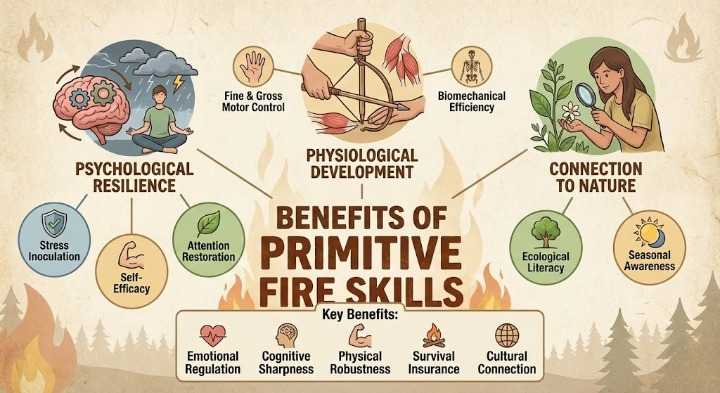
The acquisition of primitive fire-starting skills offers advantages that extend well beyond the immediate utility of boiling water or cooking food. The benefits are psychological, physiological, and cognitive, impacting the practitioner’s overall mental health and resilience.
Psychological Resilience and Stress Regulation
Recent research into the psychology of wilderness survival training highlights a profound connection between these skills and mental health. The process of learning friction fire—characterized by frequent failure, physical exertion, and the ultimate reward of a self-sustaining flame—mimics the mechanisms of cognitive behavioral therapy.
- Stress Inoculation: The high-stress environment of a survival situation often leads to panic. Training in primitive skills provides “stress inoculation,” allowing the individual to regulate cortisol levels and maintain executive function under pressure.
- Self-Efficacy: Successfully creating fire from “nothing” drastically boosts self-efficacy—the belief in one’s capacity to execute behaviors necessary to produce specific performance attainments. This psychological armor is critical in preventing the “give-up-itis” or psychogenic death often seen in hopeless survival scenarios.
- Attention Restoration: Engaging with natural materials and focusing intensely on the mechanics of a ember triggers “soft fascination,” a key component of Attention Restoration Theory (ART). This state allows the brain’s directed attention mechanisms to rest, reducing mental fatigue and anxiety.
Physiological and Motor Skill Development
The physical demands of friction fire are specific and rigorous, contributing to functional fitness.
- Fine and Gross Motor Control: The bow drill requires the synchronization of large muscle groups (latissimus dorsi, triceps) with fine motor adjustments (wrist pinning, pressure modulation). For younger practitioners, this builds essential hand-eye coordination.
- Biomechanical Efficiency: Mastery of these skills teaches the user to use their skeletal structure rather than muscular force (e.g., locking the shin in the bow drill), a principle of energy conservation vital for long-term survival.
Deepened Connection to Nature (Biophilia)
The practice fosters “biophilia,” the innate human tendency to seek connections with nature.
- Ecological Literacy: To succeed, one must become a botanist. Identifying the specific bark of a Western Red Cedar or the root of a Cottonwood tree forces a deep engagement with the local flora.
- Seasonal Awareness: The practitioner becomes acutely aware of moisture levels, wind patterns, and sun angles (for solar fire), reintegrating the human circadian rhythm with the environment.
Key Benefits Summary
- Enhanced Emotional Regulation: Mastering the frustration of the hearth board builds patience and emotional stability transferable to daily life.
- Cognitive Sharpness: The complex problem-solving required (troubleshooting wood density, humidity, and friction) keeps the mind agile.
- Physical Robustness: The repetitive motion strengthens the upper body and core, while foraging builds endurance.
- Survival Insurance: Possessing a skill that cannot be lost, broken, or depleted provides the ultimate security.
- Cultural Connection: Bridging the gap to ancestral skills provides a sense of belonging and historical grounding.
Tips to Select
Selecting the correct method and materials is the single most critical variable in the success of primitive fire making. It is a decision matrix influenced by biome, weather, and physical capability.
1. Wood Selection: The Hardness/Softness Paradox
The most common point of failure is selecting the wrong wood. The mantra “hardwood on softwood” is often misleading; in many successful traditions, the spindle and hearth are the same species.The wood must be dead, dry, and non-resinous.
The Fingernail Test
A reliable field test for wood suitability is the fingernail test. You should be able to dent the wood with your thumbnail without it feeling spongy or punky.
- Too Hard: If the wood cannot be dented, it will likely polish the mating surface (glazing) rather than abrading into dust. The friction will generate heat, but without the dust (fuel), there can be no coal.
- Too Soft: If the fingernail sinks in deeply or the wood feels like styrofoam, it is “punky” (rotted). It will crumble under pressure and absorb moisture from the air, preventing ignition.
The Snap Test
To ensure dryness, use the snap test on potential spindles or hearth branches. The wood should break with a crisp, clean “snap.” If it bends or shreds without breaking, the moisture content is too high, and the energy required to boil off that water will prevent the wood from reaching the combustion temperature of ~800°F.
2. Matching Method to Environment
The environment dictates the technique.
- Temperate/Forests: The Bow Drill is king here. Materials are abundant (Cedar, Basswood, Poplar). The mechanical advantage helps overcome the slight humidity often present in these biomes.
- Arid/Desert: The Hand Drill excels. Weeds like Mullein, Yucca, and Sotol are naturally straight, light, and bone-dry. The low humidity makes the physical exertion of the hand drill viable.
- Tropical/Wet: The Fire Saw (Bamboo) is preferred. Bamboo’s outer skin is rich in silica and stays dry inside even during rain. The saw method generates intense localized heat that can overcome ambient moisture.
- High Sun/Snow: The Ice Lens or Water Bottle Lens. In high-altitude or arctic conditions where dry wood is buried or frozen, solar methods offer a passive alternative, provided the sun is unobstructed.
3. The Geometry of the Set
Precision in carving is more important than brute force.
- The Notch: In friction fire (bow/hand drill), the notch cut into the hearth board collects the superheated dust. It should be a “V” shape, extending to the center of the divest. A notch that is too narrow suffocates the ember (lack of oxygen); a notch that is too wide allows heat to dissipate too rapidly.
- The Spindle Tip: The end of the spindle contacting the hearth should be blunt (maximizing friction surface area), while the top end (contacting the bearing block) should be a sharp pencil point (minimizing friction).
4. Troubleshooting the “Engine”
View the friction fire set as an engine.
- Smoke but no dust: You are polishing the wood. Roughen the tip of the spindle and add a pinch of sand to the socket to increase abrasion.
- Dust but no smoke: You are grinding too slowly or with insufficient pressure. The heat is dissipating faster than it is being generated.
- Brown dust vs. Black dust: Light brown dust indicates the temperature is too low. You need to increase speed. Dark black, flaky dust indicates you are close to ignition—maintain speed and slightly lighten pressure to let the coal form.
Key Selection Tips
- Material Compatibility: When possible, use the same species for spindle and hearth to ensure even wear rates.
- Biomechanical Efficiency: Choose a bow that is slightly curved and the length of your arm to maximize the stroke length; short strokes allow the dust to cool.
- Tinder Preparation: Never start drilling until your tinder bundle (bird’s nest) is fully prepped and off the ground. A coal will burn out in seconds if the nest isn’t ready.
- The Rule of Threes: Always collect enough material for three fire sets. If the first fails, you do not want to stop to forage again while your adrenaline is crashing.
- Conservation of Sweat: In a survival situation, stop before you are exhausted. If you haven’t produced smoke in 2 minutes, stop and diagnose the mechanics. Do not “muscle” through bad physics.
Detailed Methodologies: The Mechanics of Ignition
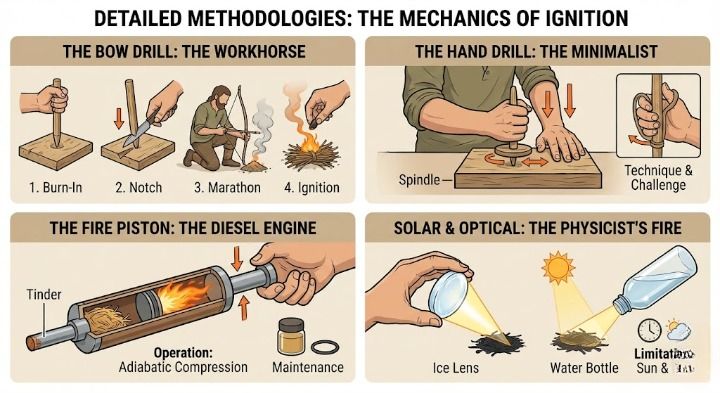
The Bow Drill: The Workhorse
The Bow Drill is the most widely taught method due to its mechanical advantage. It uses a bow to spin a spindle, a hearth board to generate friction, a bearing block to apply pressure, and a string to transfer energy.
- Step 1: The Burn-In. Create a small divot in the hearth. Spin the spindle to burn a mating socket.
- Step 2: The Notch. Cut a V-shaped notch into the socket (see “Tips”).
- Step 3: The Marathon. Assume the position—foot on the board, wrist locked against the shin. Bow back and forth with long, smooth strokes. Watch the dust pile.
- Step 4: The Ignition. When the smoke becomes thick and the dust pile is black, stop. Fan the ember gently and transfer to the tinder bundle.
The Hand Drill: The Minimalist
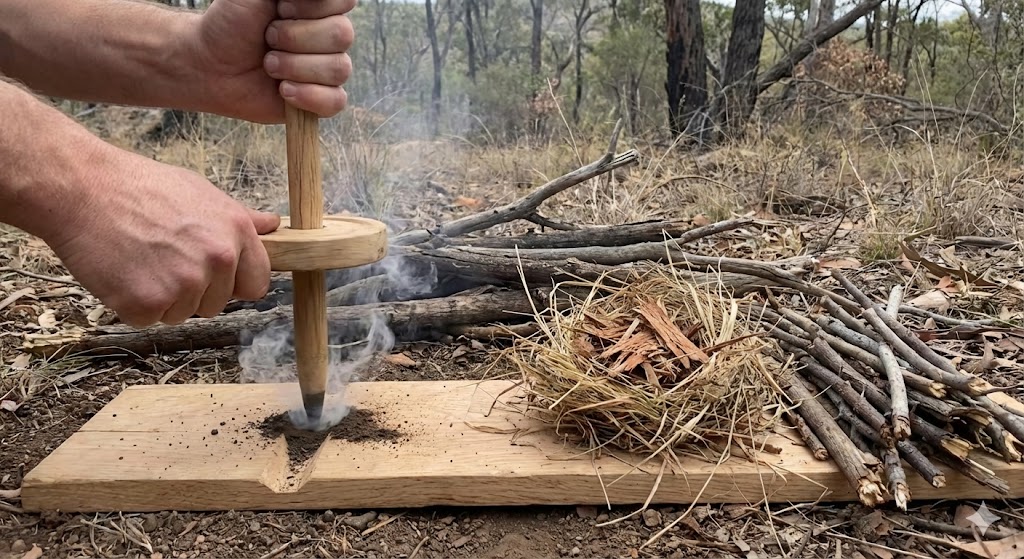
Requires only a spindle and a hearth.
- Technique: Place hands at the top of the spindle. Rub palms back and forth while pushing down. As hands move down, “float” them back to the top quickly.
- Challenge: The lack of downward pressure compared to the bow drill means speed is paramount. Use thumb loops (cordage) to help maintain downward pressure if available.
The Fire Piston: The Diesel Engine
A tube and plunger device.
- Operation: Place tinder (char cloth) in the tip of the piston. Slam the piston into the cylinder. The adiabatic compression heats the air to >500°F, igniting the tinder.
- Maintenance: Requires a perfect O-ring seal and lubrication (vaseline, animal fat) to work. It is excellent in wet weather where friction wood is damp.
Solar & Optical: The Physicist’s Fire
- Ice Lens: Freeze clear water. Shape it into a sphere or convex lens using body heat. Focus sunlight on dark tinder (char cloth, black fungus).
- Water Bottle: Use a smooth, clear bottle filled with water. Tilt to focus the sun.
- Limitations: Entirely dependent on cloud cover and time of day (10 AM – 2 PM is best).
Where to Buy: Kits, Training, and Resources
While the philosophy is to use nature, learning is often best achieved with controlled materials. The market offers high-quality kits for practice and specialized schools for instruction.
Recommended Fire Kits
For the beginner, buying a pre-made kit eliminates the variable of poor wood selection, allowing the user to focus on technique (posture, speed, pressure).
- Bow Drill Kits:
- PSKOOK Bow Drill Kit: A widely cited entry-level kit available on Amazon. It typically includes a bamboo bow (for durability) and a softer wood hearth. Reviews suggest it is excellent for understanding the mechanics, though the “learner” wheels (bearings in the handhold) should eventually be discarded for true primitive practice.
- Primitive First / Survival Gear US: These kits often feature specific wood combinations like a Cedar hearth and a hardwood spindle, optimized for North American forests. They are praised for their educational value for scouts and schools.
- Self Reliance Outfitters (Dave Canterbury): Offers robust fire kits that focus on the “10 Cs of Survivability.” Their kits often include high-carbon steel strikers and high-quality ferro rods, alongside friction fire components.
Fire Pistons and Specialized Tools
- Wilderness Solutions / Scout-Pro: Known for high-end fire pistons with pressure relief valves, making the piston easier to withdraw after ignition. These are precision-machined tools often made in the USA.
- Coalcracker Bushcraft: A reputable source for authentic flint and steel kits, including authentic chert/flint rock and hand-forged steel strikers. They also sell “char tins” for making the necessary char cloth.
- TiSurvival: For the ultra-light backpacker, they offer titanium fire pistons—indestructible and lightweight, though expensive.
Top Survival Schools and Courses
Nothing replaces hands-on instruction. The nuance of body position is difficult to convey via text or video.
- Thomas Coyne Survival Schools (California): Rated as one of the top schools, they offer “Critical Survival Skills” courses that cover primitive fire extensively. Their location allows for training in varied biomes.
- SIGMA 3 Survival School (Missouri/Global): Known for their “45 Day Survival Specialist” program. They focus on tactical and primitive skills, teaching students to source fire materials entirely from the wild.
- Wildwood Bushcraft (Scotland/UK): Specializes in “Fire by Friction” day courses. They focus intensively on the bow drill, teaching students to carve their own sets from scratch—a critical skill for true self-reliance.
- The Survival University: Offers a curriculum that blends modern survival psychology with primitive skills, emphasizing the mental resilience needed to succeed with a bow drill.
- Nature Skills/Primitive Ways: These organizations often host “gatherings” (like Rabbit Stick or Winter Count) where experts share distinct local variations of fire making, from hand drill to fire saw.
Consumer Analysis Table: Fire Starting Learning Tools
| Product/Service | Best For | Key Feature | Approximate Cost |
| PSKOOK Bow Drill Kit | Beginners/Kids | Bamboo bow, bearing handhold | ~$20 – $30 |
| Hickory Fire Piston | Gear Enthusiasts | Classic aesthetic, compression physics | ~$30 – $50 |
| Carbon Steel Striker | Historical Reenactors | Indestructible, thousands of strikes | ~$15 – $25 |
| Survival School Day Course | Serious Students | Hands-on correction of form | $100 – $150 |
| Ferrocerium Rod (Blank) | Backup Survival | Reliability in wet conditions | $5 – $20 |
Conclusion
Starting a fire with “nothing” is a journey that begins with the realization that nature provides everything. It is a discipline that marries the laws of physics with the limits of human physiology.
Throughout this report, we have explored the distinct methodologies available to the survivalist. The Bow Drill stands out as the most versatile and calorie-efficient friction method for temperate climates, balancing mechanical advantage with material availability. The Hand Drill, while elegantly simple, demands a specific biome (arid) and material set (Yucca/Mullein) to be reliable for the average practitioner. The Fire Piston and Solar Lens represent the extremes of compressive and optical physics, serving as specialized tools for specific conditions.
We have also established that the benefits of this practice extend far beyond thermal regulation. The psychological resilience forged in the repeated failures and eventual success of the friction fire hearth is a powerful tool for mental health. It fosters a “growth mindset,” reduces anxiety through “stress inoculation,” and reconnects the modern mind with the ancestral rhythms of the natural world.
For the aspiring practitioner, the path forward is clear. Begin with the best materials available—buy a kit or attend a course—to build the neural pathways of success. Learn the feel of the ember, the smell of the dust, and the sound of the friction. Then, gradually strip away the advantages. Replace the nylon cord with rawhide and Replace the bought spindle with a foraged branch. Replace the steel knife with a sharp stone.
In the end, you will find that you are no longer starting a fire with nothing. You are starting it with skill, patience, and a deep, resonant understanding of the world around you. As the embers glow and the tinder smokes, you participate in the oldest human ritual, holding back the dark and the cold with a light of your own making.
Click Here For More Information: https://ecofiy.com