



Introduction: Struggling with Minecraft Builds That Actually Work?
You finally made the tower of your dreams in Minecraft. It scrapes the sky, has a great view, and takes a long time to climb. Ladders slow you down when you go from one story to another, and stairs just don’t feel epic. You start to wonder whether there is a cooler, faster method to get up and down at that point.
Yes, there is an answer: a water elevator.
This guide will show you how to build a water elevator in Minecraft one step at a time. This solution works for both Java and Bedrock editions, so it doesn’t matter if you’re new to Redstone builds or just want a slick way to go about. You’ll learn what resources you need, how water physics operate, and how to employ soul sand and magma bricks to go up and down.
No nonsense. No hard-to-set-up things. Just a little bit of enchantment and smooth, steady movement.
Are you ready to rise to the top?
What Is a Water Elevator torch in Minecraft?
In Minecraft, a water elevator is a way to propel people or creatures up or down through a column of water. It uses water and certain blocks, including soul sand and magma, to do this.
This elevator uses the way bubbles naturally move in Minecraft. When you put water source blocks in a column and have them touch either soul sand or a magma block at the bottom, they move up or down.
What happened? A quick and attractive way to go up and down without using stairs, scaffolding, or ladders.
Water elevators are great for survival structures, towers, underwater bases, and mob farms. They work well, are quiet, and can even look good if you decorate them nicely.
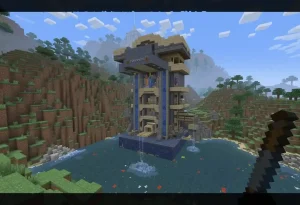
Why You Need a Water Elevator in Your Minecraft World
You know how bad it hurts when you’ve wasted time ascending a huge staircase or trying to get your villagers into tall towers. That’s when water elevators change the game.
You have a storage room underneath and a base 50 blocks above it. You can get from one level to the next in only a few seconds with a water elevator. No jumping. No damage from falling. No ladders to spam.
Water elevators are also great for farms, such iron farms or villager breeders, when you need to move mobs or stuff between different heights. In multiplayer servers, they give builds a modern style that makes your base look a lot more advanced.
And once you know how the mechanics operate, creating one is easy. It’s one of the simplest changes you can make, and you’ll use it again and over again.
How Bubble Columns Work in Minecraft
You need to know how bubble columns workai before you can make them.
In Minecraft, there are two kinds of bubble columns:
- Soul Sand Bubble Columns: These make things move up. If you put soul sand at the bottom of a column of water source blocks, bubbles will rise and lift everything inside to the top.
- Magma Block Bubble Columns: These pull players or things down. If you stand on a magma block at the bottom of a water column, whirlpool bubbles will pull you down.
The most important thing is that every block in your water elevator must be a source block, not merely a block of flowing water. That’s what makes the bubbles happen.
This means that you will need either water buckets or kelp to entirely change the water column. Don’t worry; we’ll help you through it.
Materials Needed to Build a Water Elevator
To build a simple two-way water elevator, you’ll need:
- Soul Sand – for upward movement
- Magma Block – for downward movement
- Water Buckets – to fill the elevator shaft
- Glass Blocks (or any building block) – to build the walls
- Doors or Signs – to keep water from spilling
- Kelp – to turn flowing water into source blocks
- Optional: Trapdoors or Decoration Blocks – to make it look clean
Once you’ve gathered the materials, it’s time to build.
How to Make a Water Elevator in Minecraft (Step-by-Step)
Here’s how to build a working water elevator from scratch.
Step 1: Build the Elevator Shaft
To begin, make a vertical column out of glass or other solid block. The shaft should be the same height as the elevator you want it to travel. Leave a space two blocks wide inside the shaft so that players or mobs can fit.
To keep water from leaking, make sure the shaft is completely closed.
Step 2: Place the Entrance
Put a door or two signs at the bottom of your shaft to keep the water in place while you get in. This stops the water from flooding your base.
Step 3: Add Water Source Blocks
Now put water in the whole elevator shaft. You can either put water on each block with water buckets or, for a simpler way, put water at the top and plant kelp from the bottom up. Kelp turns flowing water into source blocks on its own.
Break the kelp from the bottom once the whole shaft is full of source blocks.
Step 4: Place the Soul Sand or Magma Block
Now, at the bottom of your shaft, switch out the bottom block for soul sand to make bubbles go up, or for magma block to have them go down.
The bubbles should start working as soon as you put the block down. If they don’t, make sure that all of the water blocks are source blocks again.
Step 5: Test and Decorate
Go inside and check if you feel like you’re being pulled or lifted. You can make the elevator feel more real by adding trapdoors, colorful glass, or even redstone lamps if it works.
Making a Two-Way Water Elevator (Up and Down)
You should cover both routes for most bases. Here’s how to do that.
Make two elevators that are next to each other instead of one. One utilizes soul sand to get up. The other one goes down on a magma block. Put a sign or a trapdoor on each one to show which is which.
You can also put them on top of each other or across from each other to make them look even.
Most of today’s Minecraft bases employ this strategy. It makes your base more useful while keeping it small and efficient.
Common Mistakes to Avoid
If your elevator isn’t working, here’s what might be going wrong:
- You used flowing water instead of source blocks. Use kelp to fix this.
- The shaft is too small. Always leave at least one block of space inside for movement.
- You forgot to place a door or sign at the entrance, causing water to spill out.
- You placed the wrong block at the base. Soul sand lifts. Magma pulls down. Don’t confuse them.
Test each elevator after building to make sure the bubbles behave as expected. If not, replace the water with source blocks again and recheck the base.
Extra Ideas: Creative Water Elevator Builds
After you get the hang of the basic design, move on to the next level.
Some players use glowstone or marine lights to cover their elevator, which gives it a sleek, modern look. Some people bury the shaft completely inside walls and utilize redstone sensors to open trapdoors. You may even connect elevators to water streams so that hordes move on their own.
Water elevators are much more helpful for bases that are underwater. They fit in with their surroundings and make it easy to move around.
There are so many alternatives, and the only thing that limits them is your imagination.
FAQs About Water Elevators in Minecraft
Can I use bubble columns in Bedrock Edition?
Yes! Bubble columns work in both Java and Bedrock. Just make sure all water blocks are source blocks.
Can mobs use water elevators?
Absolutely. Villagers, zombies, and other mobs can move using water elevators, which makes them perfect for mob farms or trading halls.
Do elevators work underwater?
Yes. Just build the shaft and add the bubble column mechanics. They function normally underwater.
Is it safe to use magma blocks?
They cause a little damage. If you’re building a down elevator, add a trapdoor or carpet above the magma block to prevent players from taking damage.
Final Thoughts: Elevate Your Minecraft Game—Literally
You now know how to build a water elevator in Minecraft, which is a useful and creative trick that you may use. You don’t have to put up with slow ladders or stairs that are hard to climb anymore. Your foundation will work better, look better, and be more exciting to use with just a few blocks and some bubble magic.
Water elevators are more than simply tools; they’re improvements. They make moving around in your Minecraft world easier and provide you more design options. This method speeds things up, makes them safer, and looks better, whether you’re creating a tower, a survival bunker, or a villager elevator system.
So go ahead and create your shaft, fill it with source blocks, and rise.