







Proven Yoga for Back Pain That Instantly Eases Chronic Pain
1.1 The Global Crisis of Back Pain
Chronic low back pain is more than a localized physical ailment; it is a systemic burden that affects individuals, families, and economies. Epidemiological data indicates that LBP is the single leading cause of disability worldwide, preventing millions from engaging in work and daily activities. The economic implications are staggering, with work-related back pain alone accounting for approximately 800,000 disability-adjusted life-years (DALYs) annually.
The costs associated with LBP are bifurcated into direct and indirect categories. Direct costs include expenditures on primary care visits, physical therapy, chiropractic care, pharmacotherapy, and surgical interventions. Indirect costs, often harder to quantify but significantly more impactful, include absenteeism (missed work days) and “presenteeism” (reduced productivity while at work due to pain). Research highlights that over one-third of patients do not achieve full recovery from an initial episode of CLBP, and the majority of these individuals return to the workforce within 12 months, often while still symptomatic, leading to a cycle of recurrence and chronic disability.
1.2 The Failure of the Biomedical Model
Historically, back pain was treated through a purely biomedical lens, viewing pain as a direct result of structural tissue damage (e.g., a herniated disc). This model favored pharmaceutical suppression of symptoms and surgical correction of anatomy. However, outcomes have often been poor. “Failed Back Surgery Syndrome” (FBSS) and the opioid epidemic have underscored the inadequacy of treating CLBP solely as a structural defect.
The contemporary medical consensus advocates for a biopsychosocial model, which recognizes that pain is influenced by biological factors (tissue damage), psychological factors (distress, anxiety), and social factors (work environment). Therapeutic yoga is uniquely positioned within this model. Unlike passive treatments (e.g., painkillers), yoga is an active intervention that addresses physical mobility, psychological resilience, and somatic awareness simultaneously.
1.3 Scope of Yoga as Therapy
Yoga is defined not merely as a set of physical exercises but as a mind-body discipline that combines asanas (physical postures), pranayama (breath control), and dhyana (meditation/mindfulness). In the context of LBP, therapeutic yoga focuses on:
- Musculoskeletal Rehabilitation: Strengthening core stabilizers and increasing flexibility in the kinetic chain (hamstrings, hips).
- Neuromuscular Re-education: Correcting postural habits and movement patterns that contribute to micro-trauma.
- Autonomic Regulation: shifting the nervous system from a sympathetic (fight-or-flight) state, which exacerbates pain perception, to a parasympathetic (rest-and-digest) state.

Pathophysiology and Biomechanics of the Lumbar Spine
To understand the therapeutic mechanisms of yoga, it is essential to analyze the anatomical structures involved in LBP and how they respond to movement.
2.1 Vertebral Anatomy and the Disc
The lumbar spine (L1-L5) supports the weight of the upper body. Between these vertebrae lie the intervertebral discs—fibrocartilaginous structures with a gel-like center (nucleus pulposus) and a tough outer ring (annulus fibrosus).
- Mechanism of Injury: Discs are avascular; they lack a direct blood supply. They rely on imbibition—the exchange of fluid driven by movement—to receive nutrients and expel waste.Sedentary lifestyles starve discs of nutrition, leading to desiccation (drying out) and degeneration.
- The Yoga Effect: The compression and release inherent in yoga poses (e.g., moving from Child’s Pose to Cobra) acts as a mechanical pump, facilitating imbibition and potentially slowing degenerative disc disease.
2.2 Muscular Stabilizers and imbalances
The spine relies on a “guy-wire” system of muscles for stability.
- Global Movers: The rectus abdominis and erector spinae handle large movements.
- Local Stabilizers: The multifidus and transverse abdominis provide segmental stability to the vertebrae.
- The Pathology: In many CLBP patients, the deep stabilizers atrophy or “shut down” due to pain inhibition. The superficial muscles then compensate, leading to chronic spasms and fatigue.
- The Yoga Effect: Balancing poses (e.g., Bird-Dog, Tree Pose) and isometric holds (e.g., Plank) specifically recruit these deep stabilizers, restoring the “natural corset” of the spine.
2.3 The Kinetic Chain: Hips and Hamstrings
The lumbar spine does not function in isolation. It is inextricably linked to the pelvis.
- Tight Hamstrings: Shortened hamstring muscles pull the ischial tuberosities (sit bones) downward, forcing the pelvis into a posterior tilt. This flattens the natural lumbar curve (lordosis), increasing load on the discs.
- Tight Psoas: A tight iliopsoas (hip flexor) pulls the lumbar spine forward into excessive lordosis, compressing the facet joints.
- The Yoga Effect: Yoga is renowned for its ability to lengthen the posterior chain (via Downward Dog, Uttanasana) and open the hip flexors (via Low Lunge, Bridge), thereby neutralizing pelvic tilt and offloading the spine.
The “Bending Paradox”: Flexion vs. Extension Intolerance
One of the most critical findings in spinal rehabilitation research is the necessity of categorizing back pain by directional preference. Treating all LBP with the same yoga poses can be disastrous. The “Bending Paradox” dictates that a movement healing one condition may aggravate another.
3.1 Flexion Intolerance (The “Disc” Profile)
Flexion intolerance is characterized by pain that worsens with forward bending, sitting, or tying shoes. It is predominantly associated with disc pathology (bulges, herniations).
- Biomechanical Mechanism: Flexion compresses the anterior portion of the vertebra, hydraulically pushing the nucleus pulposus posteriorly. If the annulus is compromised, this material presses against the spinal nerve roots.
- Contraindications: Traditional yoga forward folds (Uttanasana, Paschimottanasana) can increase intradiscal pressure and exacerbate radiculopathy.
- Therapeutic Strategy: These patients require extension-based therapies. Poses like Sphinx, Cobra, and Locust utilize the McKenzie principle to centralize disc material and reduce nerve root impingement.
3.2 Extension Intolerance (The “Joint” Profile)
Extension intolerance presents as pain during standing, walking, or overhead reaching. It is commonly linked to spinal stenosis, spondylolisthesis, and facet joint syndrome.
- Biomechanical Mechanism: Extension (arching the back) narrows the spinal canal and the intervertebral foramina (where nerves exit). It also compresses the facet joints.
- Contraindications: Deep backbends (Camel, Wheel, Full Cobra) can cause “jamming” of the facets and severe nerve compression.
- Therapeutic Strategy: These patients benefit from flexion-biased movements that open the posterior aspect of the spine. Child’s Pose, Knees-to-Chest, and Cat Pose are typically relieving. The focus is on finding a “neutral spine” and avoiding hyperextension.
3.3 Diagnostic Cues for Yoga Therapists
To ensure safety, a directional assessment is vital before beginning a yoga practice:
- Does pain increase when sitting? (Likely Flexion Intolerant).
- Does pain increase when standing/walking? (Likely Extension Intolerant).
- Does bending backward cause pinching? (Extension Intolerance).
Table 1: Directional Preference and Yoga Selection
| Condition | Biomechanical Trigger | Pain Profile | Recommended Poses | Poses to Avoid/Modify |
| Herniated Disc | Flexion (Rounding) | Pain with sitting, bending forward, coughing. | Sphinx, Cobra, Standing Back Extension, Bird-Dog. | Paschimottanasana (Seated Fold), Uttanasana (Standing Fold), Sit-ups. |
| Spinal Stenosis | Extension (Arching) | Pain with walking, standing; relief when sitting. | Child’s Pose, Knees-to-Chest, Cat Pose, Happy Baby. | Camel, Wheel, Cobra, Upward Facing Dog. |
| Facet Syndrome | Extension | Sharp, localized pain when leaning back. | Child’s Pose, Supported Forward Folds, Pelvic Tilts. | Deep Backbends, Locust. |
| Spondylolisthesis | Extension | Instability pain; worse with arching. | Core stability (Dead Bug), Gentle Flexion. | All Backbends, Hamstring stretches that induce arching. |
Clinical Evidence: Review of Major Studies
The efficacy of yoga for LBP is supported by high-quality evidence from major medical institutions and systematic reviews.
4.1 The Cleveland Clinic Studies (2025)
Recent research led by Dr. Rob Saper at the Cleveland Clinic evaluated the efficacy of online yoga for CLBP.
- Methodology: A 12-week randomized clinical trial (RCT) with 140 participants assigned to either “yoga now” or “yoga later” (control) groups.
- Intervention: Participants attended virtual hatha yoga classes focusing on static holds and breathing.
- Results: The yoga group reported a reduction in pain scores from an average of 6/10 to 3/10. Notably, 34% fewer participants in the yoga group required pain medication compared to the control group. Improvements in sleep quality and physical function were sustained at the 24-week follow-up.
- Implication: This study validates telehealth yoga as a scalable, effective intervention, removing geographical barriers to access.
4.2 Agency for Healthcare Research and Quality (AHRQ) Report (2018)
- Scope: Analyzed 8 trials involving 1,466 participants.
- Findings: Found that yoga improved pain and function in both the short term (1-6 months) and intermediate term (6-12 months). The magnitude of benefit was deemed “similar to exercise,” reinforcing yoga’s position as a legitimate form of rehabilitative exercise rather than merely relaxation.
4.3 Cochrane Review (2022)
- Scope: A review of 21 trials with 2,223 participants.
- Findings: The review concluded there is low-to-moderate certainty evidence that yoga results in improvements in back-related function and pain compared to non-exercise controls. While the difference between yoga and other back exercises (like PT) was minimal, yoga offered unique benefits in terms of mental health and compliance.
4.4 American College of Physicians (ACP) Guidelines
Based on cumulative evidence, the ACP strongly recommended yoga as an initial treatment for patients with chronic low-back pain, prioritizing it over pharmacological interventions. This guidelines shift represents a major endorsement of yoga’s safety and efficacy profile.
Mechanisms of Action: How Yoga Heals
The therapeutic success of yoga is not attributable to a single factor but rather a convergence of physiological, neurohormonal, and psychological mechanisms.

5.1 Physical Mechanisms: Stability and Mobility
- Core Strengthening: Yoga poses such as Plank, Side Plank, and Boat Pose function as isometric core exercises. Unlike dynamic crunches (which can aggravate flexion-intolerant backs), isometric holds build endurance in the transverse abdominis and obliques without repetitive spinal flexion.
- Fascial Release: Chronic pain often leads to fascial densification—stiffness in the connective tissue. Yoga postures, held for 30-60 seconds, apply a sustained stretch that remodels fascia, improving sliding surfaces between muscles and reducing the sensation of “stiffness”.
5.2 Neurophysiological Mechanisms: Central Sensitization
Chronic pain changes the brain. Through a process called central sensitization, the nervous system becomes hypersensitive, amplifying signals from the back.
- Vagal Tone: Deep, slow breathing (pranayama) stimulates the vagus nerve. High vagal tone is associated with lower inflammation and reduced pain perception. Yoga shifts the autonomic nervous system from sympathetic dominance (stress/pain) to parasympathetic dominance (relaxation/healing).
- Cortical Remapping: Pain blurs the brain’s proprioceptive map of the back. By performing novel, mindful movements, yoga practitioners sharpen these cortical maps. Improved body awareness (interoception) allows the brain to inhibit nociceptive (pain) signals that are generated by fear or anticipation of movement rather than actual tissue damage.
5.3 Psychological Mechanisms: Self-Efficacy
The “locus of control” is a powerful predictor of pain outcomes. Patients who feel passive (waiting for a doctor to fix them) often have poorer outcomes. Yoga fosters an internal locus of control. Patients learn self-regulation techniques to manage their pain, leading to increased self-efficacy. Research shows that self-efficacy is a strong predictor of reduced disability and depression in CLBP cohorts.
Comprehensive Analysis of Therapeutic Asanas
This section provides a detailed biomechanical breakdown of key yoga poses, highlighting their anatomical targets, therapeutic benefits, and necessary modifications for back pain populations.
6.1 Cat-Cow (Marjaryasana-Bitilasana)
- Anatomy: Involves alternating spinal flexion and extension while in a quadruped position.
- Therapeutic Value: Acts as “neural flossing,” mobilizing the spinal cord and nerve roots within the dural tube. It warms the synovial fluid in the facet joints and improves proprioception.
- Execution: Inhale to drop the belly and lift the gaze (Cow); exhale to round the spine and tuck the chin (Cat).
- Modification: For extension intolerance, limit the depth of the “Cow” phase (arching). For flexion intolerance, limit the “Cat” phase (rounding).
6.2 Downward-Facing Dog (Adho Mukha Svanasana)
- Anatomy: An inversion that places the spine in axial traction (distraction) while stretching the entire posterior chain (calves, hamstrings, lats).
- Therapeutic Value: Uses gravity to decompress the lumbar vertebrae, creating space for discs.
- Crucial Modification: Bend the knees. Tight hamstrings will pull the pelvis into a posterior tilt, rounding the lower back and negating the spinal benefit. Bending the knees releases the hamstrings, allowing the pelvis to tilt anteriorly and the spine to lengthen fully.
6.3 Sphinx and Cobra (Bhujangasana)
- Anatomy: Prone lumbar extension.
- Therapeutic Value: Specifically targets the extension preference. Mechanically, it helps re-centralize posterior disc displacement (bulges). It also strengthens the erector spinae.
- Execution: Lie face down. Press into forearms (Sphinx) or hands (Cobra) to lift the chest. Glutes must remain engaged to stabilize the sacroiliac joint.
- Contraindication: Avoid in cases of spinal stenosis or spondylolisthesis where extension causes pinching.
6.4 Child’s Pose (Balasana)
- Anatomy: Gentle lumbar flexion and traction.
- Therapeutic Value: Opens the facet joints and elongates the paraspinal muscles. It is a position of psychological safety and rest.
- Modification: Use a bolster under the torso to reduce the angle of flexion if the pose is too intense. Place a block under the forehead to keep the neck neutral.
6.5 Bridge Pose (Setu Bandhasana)
- Anatomy: Supine hip extension.
- Therapeutic Value: Addresses “Gluteal Amnesia.” Weak glutes force the lumbar extensors to overwork. Bridge pose isolates and strengthens the gluteus maximus, offloading the lower back.
- Execution: Lie on back, knees bent. Press feet into floor to lift hips. Ensure the lift comes from the hips, not by hyperextending the lumbar spine.
6.6 Reclined Pigeon (Supine Figure-4)
- Anatomy: Hip external rotation.
- Therapeutic Value: Targets the piriformis muscle. A tight piriformis can compress the sciatic nerve (piriformis syndrome). This pose stretches the hip rotators without the compressive load of the traditional upright Pigeon pose.
- Execution: Lie on back, cross one ankle over the opposite knee, and gently pull the legs toward the chest.
- Safety: Keeping the head on the floor prevents cervical strain
6.7 Legs-Up-The-Wall (Viparita Karani)
- Anatomy: Passive inversion.
- Therapeutic Value: Allows the psoas muscle (major hip flexor) to release completely. When the psoas is tight, it pulls the lumbar spine into lordosis. This pose neutralizes the pelvis and facilitates venous return, reducing systemic inflammation.
Therapeutic Sequences and Protocols
Effective yoga therapy relies on sequencing—the order in which poses are performed. A well-designed sequence warms the tissue, mobilizes the joints, and then integrates strength.
7.1 Sequence for General Low Back Care (Non-Specific Pain)
- Warm-up: Pelvic Tilts and Cat-Cow (5 minutes). Lubricates joints.
- Activation: Bird-Dog (5 reps/side). Engages core stabilizers.
- Mobilization: Downward-Facing Dog (with bent knees). Decompresses spine.
- Strengthening: Bridge Pose (3 sets of 30 seconds). Activates glutes.
- Stretching: Reclined Pigeon and Supine Twist. Releases tension.
- Rest: Corpse Pose (Savasana) with a bolster under knees to flatten the low back.
7.2 Sequence for Sciatica Relief
- Focus: Nerve gliding and piriformis release.
- Avoid: Deep forward folds (hamstring stretches) which irritate the nerve.
- Poses:
- Knees-to-Chest (single leg): Gentle glute stretch.
- Reclined Pigeon: Deep rotator stretch.
- Sphinx Pose: If the sciatica is discogenic, this helps move the disc off the nerve.
- Legs-Up-The-Wall: Passive nerve calming.
7.3 Sequence for Desk Workers (Flexion Intolerance)
- Focus: Reversing the “slumped” posture (extension).
- Poses:
- Standing Back Extension: Place hands on hips, gently arch back.
- Pectoral Stretch: Open the chest (tight pecs contribute to kyphosis).
- Lunge: Stretch the hip flexors (tightened by sitting).
- Locust Pose: Strengthen the entire back chain.
Safety Guidelines: Contraindications and Modifications
While beneficial, yoga carries risks if performed incorrectly. Understanding contraindications is vital for preventing iatrogenic (treatment-induced) injury.
8.1 The “Red Flag” Movements
- Unsupported Forward Folds: Bending forward with straight legs (Uttanasana) places maximum shear force on L4-L5 and L5-S1 discs. For disc patients, this can cause immediate herniation or worsening of symptoms. Modification: Always hinge at the hips (not waist) and keep knees significantly bent.
- End-Range Twisting: Using leverage (e.g., pulling on the knee) to force a deep spinal twist can damage the annulus fibrosus. Twists should be active (using muscular effort) rather than passive leverage.
8.2 Hypermobility Spectrum
Patients with hypermobility (excessive flexibility) often gravitate toward yoga but are at high risk for injury. Their ligaments are lax, so they rely on joints for stability rather than muscles.
- Strategy: These patients need strength cues, not stretch cues. In Triangle Pose, they should micro-bend the knee to engage muscles rather than “locking out” the joint. The focus should be on “hugging muscle to bone”.
8.3 Acute vs. Chronic Phase
- Acute Phase (<6 weeks): During an acute spasm, aggressive yoga is contraindicated. The body is in a protective bracing state. Gentle, restorative movements (like Child’s Pose or Legs-Up-The-Wall) and breathing are appropriate. Active stretching may trigger a stretch reflex and worsen spasms.
- Chronic Phase (>12 weeks): Progressive loading and strengthening are required to overcome deconditioning and fear of movement.
The Role of Props and Equipment
Props are not “crutches” for the inflexible; they are precision tools for biomechanical alignment.
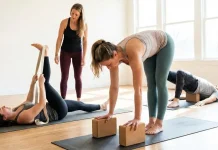
9.1 Yoga Blocks
Blocks bring the floor closer to the patient, allowing for spinal length in standing poses.
- Application: In Forward Fold, placing hands on blocks allows the patient to keep a flat back (neutral spine) rather than rounding to reach the floor. This shifts the load from the lumbar discs to the hamstrings, which is the intended target.
9.2 Yoga Straps
Straps act as arm extensions.
- Application: In Supine Hand-to-Big-Toe pose, a strap allows the patient to stretch the hamstring while keeping the head and shoulders flat on the floor. Without a strap, the patient might curl the neck up, straining the cervical spine to reach the foot.
9.3 Traction Techniques
Props can be used to create traction.
- Block Traction: Lying supine with a block under the sacrum (supported Bridge) allows the psoas to release.
- Strap Traction: Specialized techniques use a strap to apply manual traction to the leg, creating space in the hip capsule and reducing lower back compression.
Psychosocial Dimensions: Pain, Trauma, and Healing
The modern understanding of pain acknowledges that “issues in the tissues” are often linked to psychosocial stressors.
10.1 The Pain-Anxiety-Tension Cycle
Pain triggers anxiety (“Will this ever go away?”), which triggers physical tension (muscle guarding), which generates more pain. This is the Pain-Anxiety-Tension cycle.
- Yoga as Interrupter: By emphasizing “sensation without reaction,” yoga trains the patient to observe physical intensity without the emotional overlay of panic. This dampens the limbic system’s response to pain signals.
10.2 Somatic Release
Clinical narratives highlight the role of emotional trauma in CLBP. Patients often report that their pain onset correlated with life stressors (divorce, job loss).
- Mechanism: Yoga facilitates somatic release—the processing of emotion through the body. Hip-opening poses, in particular, are often associated with emotional release. By engaging with the body in a non-judgmental way, patients can reclaim a sense of safety in their physical form, reducing the “threat level” their nervous system assigns to the back.
10.3 Overcoming Kinesiophobia
Kinesiophobia is the fear of movement. Patients avoid activity to avoid pain, leading to deconditioning and stiffness.
- Graded Exposure: Yoga provides a safe, controlled environment for graded exposure to movement. Learning that one can bend or twist without catastrophic injury rebuilds confidence and breaks the cycle of avoidance.
Featured Snippet Optimization (Q&A)
Common questions addressed by this report, structured for clarity:
- “Is yoga good for lower back pain?” Yes, clinical trials show it reduces pain intensity, medication use, and disability, often comparable to physical therapy.
- “What is the best yoga pose for back pain?” There is no single “best” pose; it depends on the condition. Cat-Cow is best for general mobility, Cobra for disc issues, and Child’s Pose for stenosis.
- “Can yoga make back pain worse?” Yes, if the wrong directional preference is used (e.g., deep forward folds for disc herniation). Assessment is key.
Conclusion and Future Outlook
The integration of yoga into the standard of care for chronic low back pain represents a significant advancement in pain management. The evidence is compelling: yoga is not merely a stretching routine but a comprehensive therapy that strengthens the musculoskeletal system, regulates the autonomic nervous system, and heals the psychological wounds of chronic pain.
However, the application of yoga must be precise. The era of “generic” yoga for back pain is ending. The future lies in stratified care—tailoring yoga protocols to the specific biomechanical profile of the patient (flexion vs. extension intolerance). Medical professionals, physical therapists, and yoga therapists must collaborate to ensure patients receive safe, evidence-based guidance.
For the individual sufferer, yoga offers something that pills and surgery cannot: empowerment. It provides a toolkit for self-regulation, transforming the patient from a passive recipient of care into an active agent of their own recovery. Through consistent, mindful practice, the cycle of pain can be broken, restoring not just the spine, but the quality of life it supports.
Click Here for more: https://ecofiy.com