








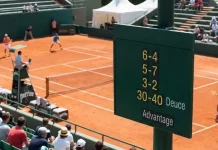

This phenomenon, often referred to as a manifestation of Simpson’s Paradox in sports, dictates that not all points are created equal. A point won at 40–0 is statistically less significant than a point won at 30–40 (a break point). The scoring system, therefore, is not merely a method of accounting; it is a narrative engine designed to generate tension, forcing players to win not just more points, but the right points. The requirement to win by a margin of two—whether in a single game at Deuce, or in a set at 5–5, or in a tiebreak—ensures that victory is rarely the result of a single lucky fluctuation, but rather the consequence of sustained, deliberate dominance.
This report provides an exhaustive examination of the tennis scoring system. It traces the obscure medieval etymologies of terms like “Love” and “Deuce,” dissects the mathematical probabilities of the “win-by-two” mechanic, analyzes the strategic imperatives of break points, and documents the historic matches—from the endurance epic of Isner vs. Mahut to the psychological warfare of Borg vs. McEnroe—that have forced the sport’s governing bodies to rewrite the rulebook. By understanding the scoring system, one gains the key to unlocking the psychological depth of the sport itself.
Part I: The Unit of Play – The Point and Its Origins
1.1 The Terminology of Points
At the most granular level, tennis scoring defies logical numerical progression. The sequence used to denote the first four points of a game—Love, 15, 30, 40—has baffled novices and linguists alike for centuries. Unlike the linear “1, 2, 3, 4” of table tennis or volleyball, tennis employs a system that seems rooted in a forgotten currency or a broken clock. A standard game is won by the first player to win four points, provided they hold a lead of two clear points over their opponent
The Standard Progression
The points are called as follows, with the server’s score always announced first to maintain clarity and order on the court.
| Points Won | Call | Context |
| 0 | “Love” | The starting state of every game. |
| 1 | “15” | The first point won. |
| 2 | “30” | The second point won. |
| 3 | “40” | The third point won. |
| 4 | “Game” | Victory, if the player is ahead by 2 points (e.g., 40-0, 40-15, 40-30). |
When both players have won the same number of points, the score is described with the suffix “All” (e.g., “15-All,” “30-All”). However, the term “40-All” is forbidden in standard nomenclature; instead, the game enters the state of Deuce, a high-stakes deadlock that transforms the game from a race into a battle of attrition.
1.2 Etymological Roots: Clocks, Eggs, and Geometry
The origins of this peculiar numbering system are shrouded in historical debate, with theories ranging from medieval horology to French linguistics. There is no single consensus, but the competing theories provide a fascinating glimpse into the sport’s evolution from the monastic cloisters of France to the manicured lawns of Wimbledon.
The Clock Face Theory
One of the most persistent and visually intuitive theories suggests that medieval courts used clock faces to track the score. In this model, the game was viewed as a complete circle (60 minutes). Each point won would move the minute hand forward by a quarter turn:
- First point: 15 minutes.
- Second point: 30 minutes.
- Third point: 45 minutes.
- Fourth point: 60 minutes (Game Over).
Historians argue that over time, the call of “45” was shortened to “40” for rhythmic efficiency. “Forty” is a disyllabic word (two syllables) that matches the cadence of “Fifteen” and “Thirty,” whereas “Forty-five” is trisyllabic and cumbersome to shout across a court during active play.
However, skeptics of this theory note a significant historical anachronism: minute hands were not a common feature on clocks in the Middle Ages when the game of Jeu de Paume (the precursor to tennis) was developing, casting doubt on the timeline of this explanation.
The Jeu de Paume “Court Geometry” Theory
A more spatially grounded hypothesis links the scoring to the physical dimensions of the court in Jeu de Paume. The court was approximately 90 feet long, or 45 feet per side. It is theorized that the scoring system was a literal representation of territorial gain. With each point won, the server was permitted to advance closer to the net to deliver the next serve:
- 1st Point: The server moves to the 15-foot mark.
- 2nd Point: The server moves to the 30-foot mark.
- 3rd Point: The server moves to the 40-foot mark (stopping short of the net to avoid being too close).
This theory aligns the “40” call directly with physical measurements rather than an arbitrary abbreviation of 45. It suggests that early tennis was a game of siege, where points correlated to the capturing of ground.
The Linguistic Mystery of “Love”
The use of “Love” to signify zero is one of sport’s most famous idiosyncrasies. Three primary theories compete for dominance:
- L’oeuf (The Egg): The most widely accepted theory posits that the French word for egg, l’oeuf, was used to describe the zero on the scoreboard due to its visual resemblance to an egg (an oval shape). English speakers, hearing the French pronunciation across the Channel, Anglicized the sound l’oeuf into “Love”.This etymological drift has a parallel in cricket, where a score of zero is called a “duck,” shortened from “duck’s egg.”
- Lof (Honor): A secondary theory suggests a derivation from the Dutch or Flemish word lof, meaning honor. The cultural implication is that a player with zero points is not playing for money or stakes, but for honor alone—or “for the love of the game”.
- Gambling Terminology: Tennis was a heavy gambling sport in the 17th and 18th centuries. Some historians suggest “love” implies “nothing” in the context of wagering; to play for love was to play without stakes, hence having “nothing” on the board.
1.3 The Mechanics of Deuce
The concept of Deuce is central to the drama of tennis. It represents the “win-by-two” philosophy distilled to its essence. When the score reaches 40–40, the game cannot be won by a single point.
- Deuce: The state of parity at 3 points each.
- Advantage In (Ad-In): If the server wins the point at Deuce, they hold “Advantage.” They are one point away from winning the game (Holding Serve).
- Advantage Out (Ad-Out): If the receiver wins the point at Deuce, they hold “Advantage.” They are one point away from winning the game (Breaking Serve).
If the player with Advantage loses the subsequent point, the score reverts to Deuce, and the struggle continues. This mechanism can theoretically lead to games of infinite duration, as illustrated in the longest recorded tiebreaks and sets in history. The term “Deuce” itself is derived from the French à deux de le jeu (two points from the game), or simply deux (two), signifying the two consecutive points required to finish.
Part II: The Game, The Set, and The Match
2.1 The Game: Serving and Receiving
Victory in a game is achieved by navigating the point system to its conclusion. Tactical dominance in tennis is heavily weighted toward the server. The serve is the only shot in tennis initiated from a static position, allowing the player complete control over the ball’s speed, spin, and placement. Consequently, winning a game while serving is statistically expected and is termed a “Hold.” Winning a game while receiving is a significant disruption and is termed a “Break.” Because one break of serve is often sufficient to decide a set, the Break Point—any point where the receiver can win the game (e.g., 30–40, 15–40, 0–40)—is statistically the most critical moment in a match.
The Let Rule:
An idiosyncratic feature of game play is the “Let.” If a serve hits the net cord but still lands within the correct service box, the serve is void and must be replayed. There is no limit to the number of Lets that can occur consecutively. This rule exists to prevent luck (the ball dribbling over the net) from deciding the start of a point, ensuring the receiver has a fair chance to return a clean ball. However, in standard play during a rally (after the serve), a net cord shot that lands in is considered “play on,” often resulting in a lucky winner for the striker.10
2.2 The Set: Architecture and Variations
A set is a collection of games. To win a standard “Advantage Set,” a player must win six games with a margin of at least two games over their opponent.
- Standard Wins: 6–0, 6–1, 6–2, 6–3, 6–4.
- Extension: If the score reaches 5–5, the set must continue to at least 7 games.
- If a player wins the next two games (7–5), the set ends.
- If the score reaches 6–6, a Tiebreak is played to decide the winner (7–6).
Historically, prior to the invention of the tiebreak, sets would continue indefinitely until a two-game margin was achieved. This led to marathon scores like 12–10 or 16–14. Today, such “Advantage Sets” have been largely phased out of professional tennis to protect player health and television schedules, with the tiebreak acting as the definitive conclusion to a set.
2.3 The Tiebreak: The Game Within a Game
Invented by James Van Alen in 1965 to curb the length of matches, the tiebreak is a unique scoring format used when a set reaches 6–6.
- Scoring: Points are counted numerically (1, 2, 3…) rather than using the 15-30-40 system.
- Objective: The first player to reach 7 points, leading by 2.
- Service Rotation: To ensure fairness, the serve alternates:
- Point 1: Player A serves (Deuce court).
- Points 2-3: Player B serves (Starting Ad court, then Deuce).
- Points 4-5: Player A serves.
- This 1-2-2 pattern continues until the tiebreak concludes.
- Change of Ends: Players switch sides of the court every 6 points (e.g., 3–3, 4–2, 6–0) to ensure neither player benefits disproportionately from wind or sun.
The winner of the tiebreak takes the set 7–6. The loser’s score in the tiebreak is often denoted in parentheses in official records—e.g., 7–6(4) indicates the loser scored 4 points in the tiebreak.
2.4 The Match: Endurance vs. Sprint
Tennis matches are played in one of two formats:
- Best-of-Three Sets: The first player to win two sets wins the match. This is the standard format for the WTA (Women’s Tour), most ATP (Men’s Tour) events, and Mixed Doubles.
- Best-of-Five Sets: The first player to win three sets wins the match. This grueling format is reserved for Men’s Singles at the four Grand Slam tournaments (Australian Open, Roland Garros, Wimbledon, US Open) and historically the Davis Cup. A five-set match is a supreme test of physical conditioning and mental fortitude, often lasting between three and five hours.
Part III: The Grand Slam Evolution (2019-2022)
The most significant recent change in tennis scoring concerns the “Final Set.” For decades, the four Grand Slams had different rules for the deciding set (3rd for women, 5th for men) when the score reached 6–6.
- US Open: Used a standard 7-point tiebreak.
- Australian Open: Introduced a 10-point “Super Tiebreak.”
- Wimbledon: Played an Advantage Set until 12–12, then a tiebreak (introduced after 2018).
- Roland Garros: Adhered to the traditional Advantage Set (no tiebreak, play until win by 2 games).
This inconsistency confused fans and players alike. In March 2022, the Grand Slam Board announced a historic unification. All four majors now utilize a 10-Point Match Tiebreak when the final set reaches 6–6. The first player to reach 10 points, leading by 2, wins the match. This rule change effectively ended the era of the “infinite match,” ensuring that even the closest contests have a definitive, scheduled conclusion.

Part IV: Historical Case Studies and Anomalies
The necessity of rule changes and the allure of tennis psychology are best understood through the specific matches that broke the system.
4.1 The Endless Marathon: Isner vs. Mahut (Wimbledon 2010)
This first-round match is the statistical outlier against which all tennis records are measured. It remains the longest match in history by duration and number of games, a feat unlikely to ever be repeated due to the 2022 rule changes.
The Narrative
Played on Court 18 at Wimbledon, the match spanned three days. It began on a Tuesday evening, was suspended for darkness after the fourth set, resumed Wednesday, continued until darkness suspended it again at 59–59 in the fifth set, and finally concluded on Thursday.
The Statistics
- Final Score: John Isner def. Nicolas Mahut 6–4, 3–6, 6–7(7), 7–6(3), 70–68.
- Total Duration: 11 hours and 5 minutes.
- Fifth Set Duration: 8 hours and 11 minutes (longer than any other full match in history).
- Games Played: 183 total games.
- Aces: Isner hit 113 aces; Mahut hit 103. Both shattered the previous world record.
- Scoreboard Failure: At 47–47 in the fifth set, the electronic scoreboard on Court 18 malfunctioned and went blank; programmers had never coded it to display scores beyond that number.
This match was the primary catalyst for the eventual abolition of the Advantage Set. While a testament to human will, it left both players physically shattered; Isner lost his next round match in straight sets, unable to move effectively.
4.2 The Psychological War: Borg vs. McEnroe (Wimbledon 1980)
If Isner-Mahut was a physical anomaly, the 1980 Wimbledon final between Björn Borg and John McEnroe was a psychological masterpiece. The fourth-set tiebreak is widely considered the greatest passage of play in the sport’s history.
The Scoring Dynamics
Borg led 2 sets to 1 and had championship points in the fourth set tiebreak. McEnroe, displaying his trademark volatility and brilliance, saved five match points. Conversely, McEnroe needed seven set points to finally close out the tiebreak.
- Tiebreak Score: McEnroe won 18–16.
- Implication: A standard tiebreak is first to 7. This tiebreak required 34 points because neither player could secure the requisite two-point lead.
- Aftermath: Despite losing the exhilarating tiebreak, Borg recovered his mental composure to win the fifth set 8–6, securing his fifth consecutive Wimbledon title. The match underscored that in tennis scoring, losing a battle (the tiebreak) does not necessarily mean losing the war, provided mental resilience is maintained.
4.3 The Golden Set: Yaroslava Shvedova (Wimbledon 2012)
A “Golden Set” is the rarest scoring feat in tennis: winning a set 6–0 without losing a single point. Statistically, this requires winning 24 consecutive points (4 points x 6 games).
- The Match: Yaroslava Shvedova vs. Sara Errani (2012 Wimbledon, 3rd Round).
- The Feat: Shvedova, a wildcard, produced a flawless display of power against the 10th seed Errani. She hit 14 winners and 4 aces in the first set, winning it 6–0 in just 15 minutes.
- Context: It is the only Golden Set ever recorded in the main draw of a Grand Slam. The only other top-level Golden Set in the Open Era was achieved by Bill Scanlon in 1983.27
- Significance: The Golden Set illustrates the momentum-based nature of tennis scoring. Once a player dominates the rhythm of both serve and return, the “reset” of a new game does not necessarily interrupt the flow of points.
4.4 The Shortest Final: Graf vs. Zvereva (Roland Garros 1988)
In stark contrast to marathon matches, the scoring system also allows for brutal efficiency. Steffi Graf defeated Natalia Zvereva 6–0, 6–0 (a “Double Bagel”) in the 1988 French Open final. The match lasted only 34 minutes. It remains the shortest Grand Slam final in history, demonstrating how quickly the “win-by-two” mechanic can snowball into a rout if one player cannot gain a foothold.

Part V: Strategic Nuances and Psychological Warfare
5.1 The Psychology of Break Points
A Break Point is a statistical crisis for the server and a golden opportunity for the receiver. Because the server dictates the point’s start, holding serve is the baseline expectation in professional tennis (especially in the men’s game). Therefore, a break of serve is often the decisive factor in a set.
- Types of Break Points:
- 30–40: A standard break point. High pressure.
- 15–40: Double break point. The receiver has two consecutive chances to win the game.
- 0–40: Triple break point. A virtual death sentence for the service game.
- Tactical Shift: Research indicates that on break points, successful returners often target the “outer thirds” of the court or aim deep down the middle to neutralize the server’s angle creation. Conversely, servers are advised to aim for high-percentage “body serves” to jam the receiver rather than risking low-percentage aces.
5.2 The “Seventh Game” Myth
Tennis lore places immense weight on the “Seventh Game” of a set (when the score is 3–3 or 4–2). It is often described by commentators as the pivotal moment where the ball change (new balls are introduced after the first 7 games and then every 9 games) and mental fatigue intersect. While statistical analysis shows that every break point is valuable, the psychological weight placed on the seventh game often becomes a self-fulfilling prophecy, increasing the tension for the server.
5.3 Saving Match Point: The “Windshield Wiper”
Facing a Match Point is the ultimate test of nerve. Sports psychologists working with elite players often utilize the “windshield wiper” visualization technique: the player must mentally “wipe away” the previous error or the scoreline and play the point in a vacuum. The scoring system aids this: whether it is 15–15 in the first game or Advantage Out in the final game, the mechanics of hitting a forehand remain identical. The player who can dissociate the mechanic from the consequence is most likely to save the match point.
5.4 Momentum and Simpson’s Paradox
Because tennis is scored in compartments (games/sets), a player can win fewer points than their opponent but still win the match.
- Example: Player A wins the first set 6–0 (winning 24 points to roughly 5). Player B wins the next two sets 7–6, 7–6 (winning games by narrow margins).
- Result: Player B wins the match, despite Player A winning more total points and more total games.
This reality forces players to prioritize efficiency in “big moments” (tiebreaks, break points) over mere accumulation of points.
Part VI: Variations and Alternative Formats
6.1 Doubles and Mixed Doubles Scoring
To make doubles matches more predictable for television and less physically taxing, alternative scoring rules are often employed.
- No-Ad Scoring: At 40–40, a single “Deciding Point” is played. The receiving team chooses which player will receive the serve (Deuce or Ad side). The winner of this point takes the game. This eliminates the infinite Deuce loops.
- Match Tiebreak: In lieu of a full third set, a “Match Tiebreak” (first to 10 points) is played. This is standard in Mixed Doubles at Grand Slams and most ATP/WTA doubles events (though Wimbledon Men’s Doubles retained best-of-five sets longer than others before aligning recently).
6.2 Fast4 and Mini Tennis
Designed to engage younger audiences and fit into tighter broadcast windows:
- Fast4: Sets are played to 4 games (tiebreak at 3–3). No-Ad scoring is used, and “Lets” are played (if a serve hits the net and lands in, it is live play).
- Mini Tennis (Red/Orange/Green): Uses simplified scoring (e.g., match tiebreaks to 10) and modified balls/courts to teach children fundamentals without the daunting length of full sets.2
6.3 NCAA (College) Rules
Collegiate tennis in the US prioritizes speed and aggressive play.
- No-Ad Scoring: Strictly enforced in both singles and doubles.
- Service Lets: In some divisions, service lets are played, adding a chaotic element where players must react to erratic net cords on serves.
- Set Structure: Doubles is often one set to 6; Singles is best of 3 sets.
Part VII: Equipment, Physics, and Trivia
7.1 The Impact of Equipment on Scoring
The evolution of tennis technology has directly influenced scoring trends.
- Racquet Technology: The shift from wood to graphite and polyester strings allowed for massive topspin and power. This increased the dominance of the serve, leading to the proliferation of tiebreaks in the modern game (post-1990s).
- Yellow Balls: Originally, tennis balls were white or black depending on the court color. The switch to “Optic Yellow” was driven by television: research showed that yellow balls were more visible to viewers on color TV screens. This change helped popularize the sport, bringing the intricacies of the scoring system to a global audience.
7.2 Tennis Trivia and Anomalies
- King James I: The Scottish King was an avid player of early tennis. He famously blocked a sewage drain on his court because he kept losing balls in it; ironically, when he later tried to escape assassins through that same drain, he found it blocked and was killed. A grim reminder of the sport’s royal roots.
- Pineapples: The Wimbledon trophy features a pineapple on top. This dates back to a tradition where pineapples were symbols of rare luxury and hospitality in England.
- The Longest Rally: In 1984, Vicki Nelson and Jean Hepner played a single point that lasted 29 minutes and 643 shots. The ball crossed the net over 600 times before Nelson finally won the point. This rally epitomizes the “win-by-two” attrition warfare of tennis.
- Fastest Serve: Australian Sam Groth holds the record for the fastest serve at 163.7 mph (263.4 km/h). Such speed renders the receiver’s reaction time almost non-existent, turning the scoring system into a pure test of the server’s accuracy.
Part VIII: USTA Ratings and The “Dynamic” Score
For recreational players in the United States, the scoring system has a secondary implication: the NTRP Rating (National Tennis Rating Program).
- The Myth: Many players believe winning 6–0, 6–0 improves their rating more than winning 6–4, 6–4.
- The Reality: The USTA uses a “Dynamic Rating” algorithm that calculates a player’s rating to the hundredth of a point. It factors in the rating of the opponent and the margin of victory. However, the algorithm is famously secretive. Winning against a much lower-rated opponent, even decisively, may not improve a rating, whereas losing a close match (e.g., in a tiebreak) to a much higher-rated opponent can actually raise a player’s dynamic rating. This system ensures that the scoreline reflects not just a win/loss, but the relative quality of play.
Part IX: Glossary of Essential Scoring Terms
| Term | Definition | Context/Nuance |
| Ace | A legal serve not touched by the receiver. | Wins the point immediately. |
| Ad-In | Advantage to the Server. | Server needs 1 point to hold. |
| Ad-Out | Advantage to the Receiver. | Receiver needs 1 point to break. |
| Bagel | A set won 6–0. | Total dominance. |
| Breadstick | A set won 6–1. | Visual reference to the number “1”. |
| Double Fault | Missing both 1st and 2nd serves. | Point awarded to opponent. |
| Golden Set | Winning a set without dropping a point. | Extremely rare (Shvedova). |
| Hold | Winning a game while serving. | The expected outcome in pro tennis. |
| Let | A serve hitting the net but landing in. | Replay the serve. |
| Love | Zero points. | From l’oeuf (egg) or lof (honor). |
| Match Point | One point away from match victory. | High psychological pressure. |
| Walkover | Opponent withdraws before match. | Winner advances without playing. |
| Retirement | Opponent quits during match. | Score recorded as is (e.g., 6-2, 2-0 Ret.) |
Conclusion: The Endurance of Tradition
The tennis scoring system is a masterpiece of sporting design. Its strange vocabulary—Love, Deuce, Let—serves as a linguistic bridge to its medieval past. Its mathematical structure—the requirement to win by two—serves as a formidable barrier to luck, ensuring that victory is earned through consistency rather than chance.
From the grassy courts of Wimbledon where Isner and Mahut played for three days, to the red clay of Paris where matches can turn into physical chess, the scoring system remains the constant variable. It adapts to new demands (the 10-point tiebreak) while preserving its core identity. Whether you are a casual fan puzzled by “15-Love” or a seasoned player calculating the dynamic rating implications of a third-set tiebreak, understanding the score is understanding the soul of tennis. It is a sport where you can have “Love” and still lose, where you can win more points and still be defeated, and where a single “Let” cord can change the course of history.